

In this article, we compare the well-to-well homogeneity and filtration speed of our AcroPrep™ Advance 96-well filter plates with alternative products from Merck Millipore and Agilent. All three brands demonstrated similar retention of latex beads. The filter plates show a statistically significant, faster filtration and improved well-to-well homogeneity when processing a Ponceau S/glycerol solution compared to the Merck Millipore and Agilent plates.
Introduction
Biomolecules from different cell lines need to be isolated, purified, and concentrated. These three processes form the backbone of the bioprocessing industry and in the academic research lab. Numerous innovations in automation have accelerated this process and led to faster development of novel drugs, targeted antibodies, and quicker detection of diseases.
Multiwell plates are one such innovation, which help in the quick filtration, isolation, and purification of your biomolecules. Our AcroPrep™ Advance 96-well filter plates come with a 0.2 µm pore size Supor™ polyethersulfone (PES) filter membrane to minimize protein and nucleic acid binding for rapid and efficient purification of biomolecules.
In this application note, we compare well homogeneity and speed of filtration of AcroPrep™ Advance 96-well filter plates with Merck Millipore Multiscreen and Agilent ValueLab 96-well filter plates, which contain a 0.22 µm pore size polyvinylidene fluoride (PVDF) membrane.
MATERIAL AND METHODS
We performed all experiments described in the materials and methods section at the Cytiva Harbourgate site (Portsmouth, UK). Experiments were performed using five replicates from the same lot of AcroPrep™ Advance 96-well filter plates containing a 0.2 µm Supor™ PES membrane, and Merck Millipore Multiscreen and Agilent ValueLab 96-well filter plates, which contain a 0.22 µm PVDF membrane.
Assessment of particle retention homogeneity in 96-well filter plates
We determined homogeneity of the 96-well filter plates by passing 250 µL of a latex bead solution under vacuum. We read the absorbance of the resulting filtrate at 700 nm for cloudiness, and at 260 nm, which is the optimum wavelength for the latex bead solution. We calculated the bead retention per well from the absorbance of the initial latex bead solution loaded per well.
Assessment of filtration time in 96-well filter plates
We established filtration time in 96-well plates using a colored solution made up of 0.1 mg of Ponceau red solubilized in 50% (v/v) glycerol. All filtrations were performed under vacuum, at a pressure of 10 inHg and the absorbances recorded at 530 nm (specific to the Ponceau S solution) using a Tecan Infinite plate reader.
To assess the filtration time per well of the 96-well plate, we pipetted 250 μL of the Ponceau S/glycerol solution into each well of the filter plate and filtered under vacuum into a collection plate containing 250 μL of reverse osmosis (RO) water per well. The absorbance of the Ponceau S/glycerol solution and the time taken to fully filter 250 μL, were recorded. At mid-filtration time (before emptying all the wells), we performed the partial filtration of the 250 μL of Ponceau S/glycerol solution and recorded absorbances of the diluted solution in each well of the collection plate (containing 250 μL RO water).
The filtration time per well of the full 250 μL of Ponceau S/glycerol solution was extrapolated from the actual filtration data recorded for the full 250 μL of Ponceau S/glycerol solution.
Results and discussion
We compared bead retention and processing time between wells of 96-well filter plates from Cytiva containing a 0.2 µm Supor™ PES membrane, and Merck Millipore and Agilent wells containing a 0.22 µm PVDF membrane.
Although latex bead retention percentages were in close agreement for all plates, we observed many wells with low retention for the Agilent plates, resulting in a larger standard deviation (Table 1 and Fig 1). However, significant differences in latex bead retention were observed between Cytiva vs Merck Millipore (p < 0.05), Cytiva vs agilent (p < 0.05), and Merck Millipore vs Agilent (p < 0.05) plates (Fig. 1).
Table 1. Cytiva, Merck Millipore, and Agilent filter microplates were assessed for bead retention and processing time of Ponceau S/glycerol solution1
| Supplier | Average latex bead retention (%) at 260 nm | Average Ponceau S/gycerol processing time (s) |
| Cytiva | 99.6 ± 0.6 | 47 ± 8 |
| Merck Millipore | 99.5 ± 0.4 | 67 ± 20 |
| Agilent | 98.3 ± 4.8 | 88 ±12 |
1See Figure 1 and Figure 2 for statistical analysis.
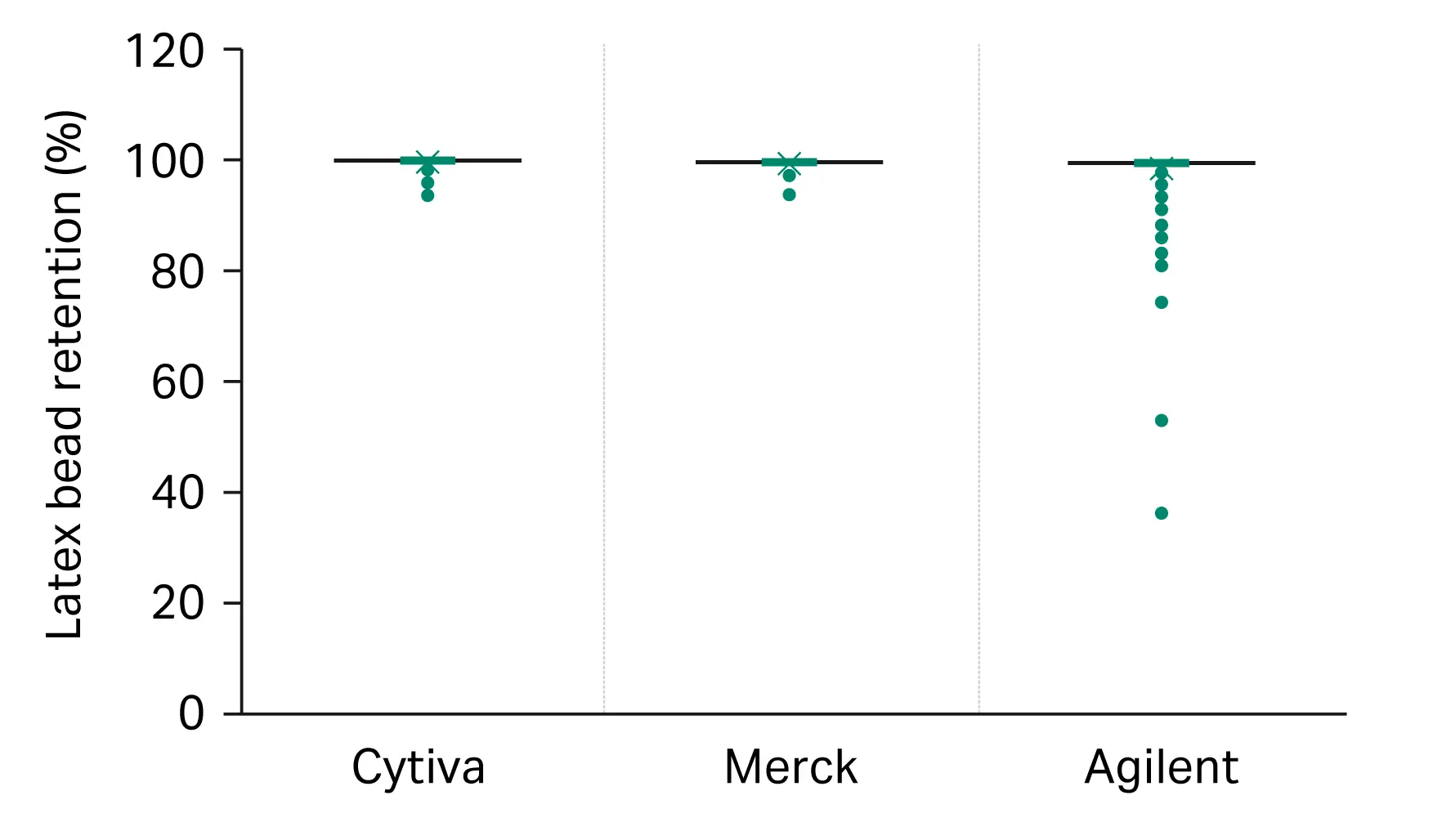
Fig 1. Box plot of latex bead retention in filtration plates. The box plot demonstrates the variability in latex bead retention after filtration under vacuum through AcroPrep™ Advance 96-well plates from Cytiva compared to Merck Millipore Multiscreen and Agilent ValueLab 96-well filter plates (n = 480 wells tested). Significant differences in latex bead retention were observed by a two-sample t-test assuming unequal variance between Cytiva vs Merck Millipore (p < 0.05), Cytiva vs Agilent (p < 0.05), and Merck Millipore vs Agilent (p < 0.05) plates.
The average processing time of Ponceau S/glycerol solution was faster in our filter plates compared to both Merck Millipore and Agilent (Table 1 and Fig 2). The processing time was more homogenous across the wells of Cytiva and Agilent filtration plates compared to Merck Millipore plates (Fig 2). However, we observe statistically significant differences in processing times between Cytiva vs Merck Millipore (p < 0.05), Cytiva vs Agilent (p < 0.05), and Merck Millipore vs Agilent (p < 0.05) plates.
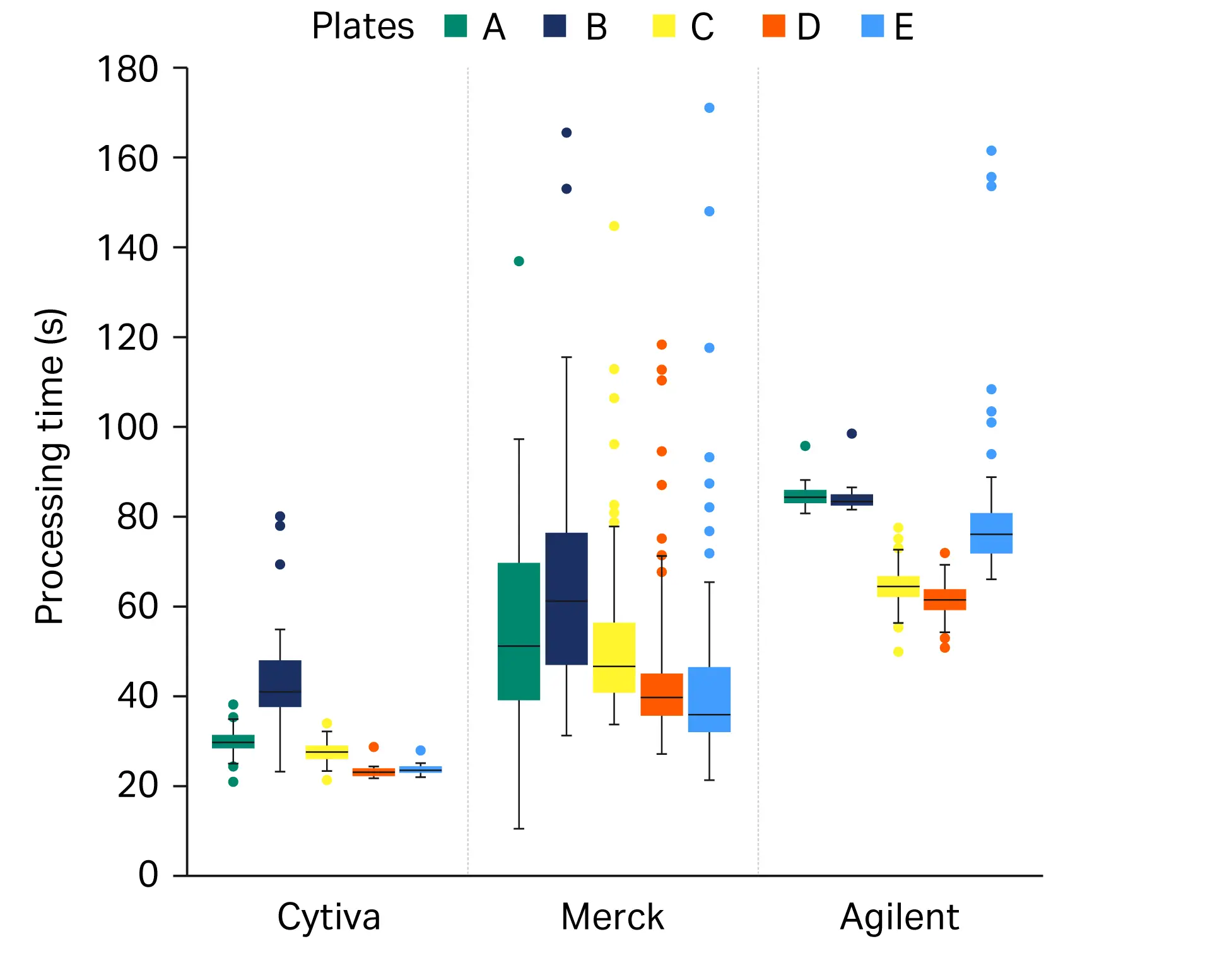
Fig 2. Box plot of processing time of Ponceau S/glycerol solution in filtration plates. The box plot demonstrates the variance in processing times of Ponceau S/glycerol solution in five individual filtration plates from AcroPrep™ Advance 96-well filter plates from Cytiva compared to Merck Millipore Multiscreen and Agilent ValueLab 96-well filter plates (n = 440 wells tested). We observe significant differences in processing times overall by a two-sample t-test assuming unequal variance between Cytiva vs Merck Millipore (p < 0.05), Cytiva vs Agilent (p < 0.05) and Merck Millipore vs Agilent (p < 0.05) plates.
Conclusion
This study shows that AcroPrep™ Advance 96-well filter plates containing 0.2 µm Supor™ PES membrane are well-suited for automation applications, due to:
- Good latex bead retention with low variability.
- Fast processing times.
- Homogeneity in processing time in wells across the filter plate, producing a reliable filtration step.
CY53887