Here we provide examples of how companies have utilized service effectively to keep operations running efficiently and top tips to stay resilient.
Every minute counts
Picture a facility where scientists race to make cell therapies, vaccines, and other therapeutics. The equipment they rely on must run smoothly. If a key instrument isn’t running properly, work stops. That means delays, missed goals, and potentially longer patient wait times. As companies grow and regulations get tougher, keeping things running isn’t just helpful − it’s vital.
Successful companies have resilient operations
If you work in biopharma, you know that there’s constant pressure: Tight production schedules. Scale-up demands. The risk of costly downtime. Waiting for spare parts and qualification can wreak havoc on manufacturing timelines and product delivery.
To stay resilient, companies like yours are turning to smart service strategies, such as predictive maintenance and care contracts that help stop potential issues before they arise. It’s important to match service plans with capacity forecasts and inventory needs, so you can streamline your operations and compliance. By preplanning and building in flexibility, your team can reduce risk, meet deadlines, and keep production on track – even if unexpected challenges come up.
Case study: A vaccine hub in Korea had a big task
A vaccine hub in Korea needed to set up and qualify 32 chromatography tools in just 10 weeks. Travel was tight. Time was short. They needed a team of engineers to work side-by-side with the customer, even at weekends to hit the deadline. This type of support is mainly possible when there is a care contract in place that commits to providing engineering capacity, response times, and achieving the final result within set timelines. This is an example of how choosing a service care contract that matches your lab’s capacity can help you think ahead and avoid delays.
Case study: They couldn’t stop during the pandemic
A vaccine facility in Italy had systems that needed maintenance during the COVID pandemic. But travel was tough, and hotels were closed. Still, they couldn’t afford to stop. With the customer signed up to a care package, it meant that a solution needed to be found. Engineers were allocated from the local network meaning the team could, commute daily to keep six key systems running. No delays. No downtime. This example shows how you can keep your lab resilient in a variety of ways, including stocking critical parts in anticipation of future inventory needs and scheduling qualifications to stay compliant.
Find out more about care packages
Cutting downtime saves time and money
Equipment issues can derail production, bring costly delays, compromise data, and lead to batch loss. These disruptions ripple across the supply chain. Even a few hours of downtime can translate into a major financial risk and could leave patients unserved.
To keep equipment running, companies are getting proactive – using strategies such as remote diagnostics and central hubs to manage all their equipment. Remote monitoring allows teams to detect when something isn’t right, while service-level agreements (SLAs) and escalation protocols provide swift resolution when issues arise. By managing all equipment in one place, teams can gain real-time visibility and control of system status and needed service.
Case study: A US company races to make cancer treatments
This bustling cell therapy company had nearly 200 instruments across 2 sites. Keeping them running was no small endeavor. With a hub to manage all equipment assets, called My Equipment web tool, they made it simple. Repairs were easy to request online. And service visits were timely.

Tips to reduce downtime
- Acknowledge advisory notices to stay ahead of potential issues.
- Train teams to use remote tools and interpret diagnostics.
- Track service history to identify patterns and optimize maintenance schedules.
Learn more about My Equipment web tool
Resolve issues quickly with digital tools
Staffing shortages, knowledge gaps, and troubleshooting delays translate into slow decision-making and long response times. Even minor disruptions can push back timelines and compromise data integrity. As manufacturing becomes more complex, there’s a growing need for smarter, more agile support that empowers teams to stay ahead of issues rather than react to them. Traditional service models aren’t sufficient to meet current demands.
Embracing remote service tools allow in-house technicians to view and resolve equipment issues with or without virtual support from the vendor – which reduces downtime and improves control. Digital tools such as augmented reality are being used to train operators, so they can troubleshoot confidently on their own. These innovations not only improve response times but also foster a culture of proactive problem-solving to build your staff’s know-how.
Case study: A defrosted sample was at risk
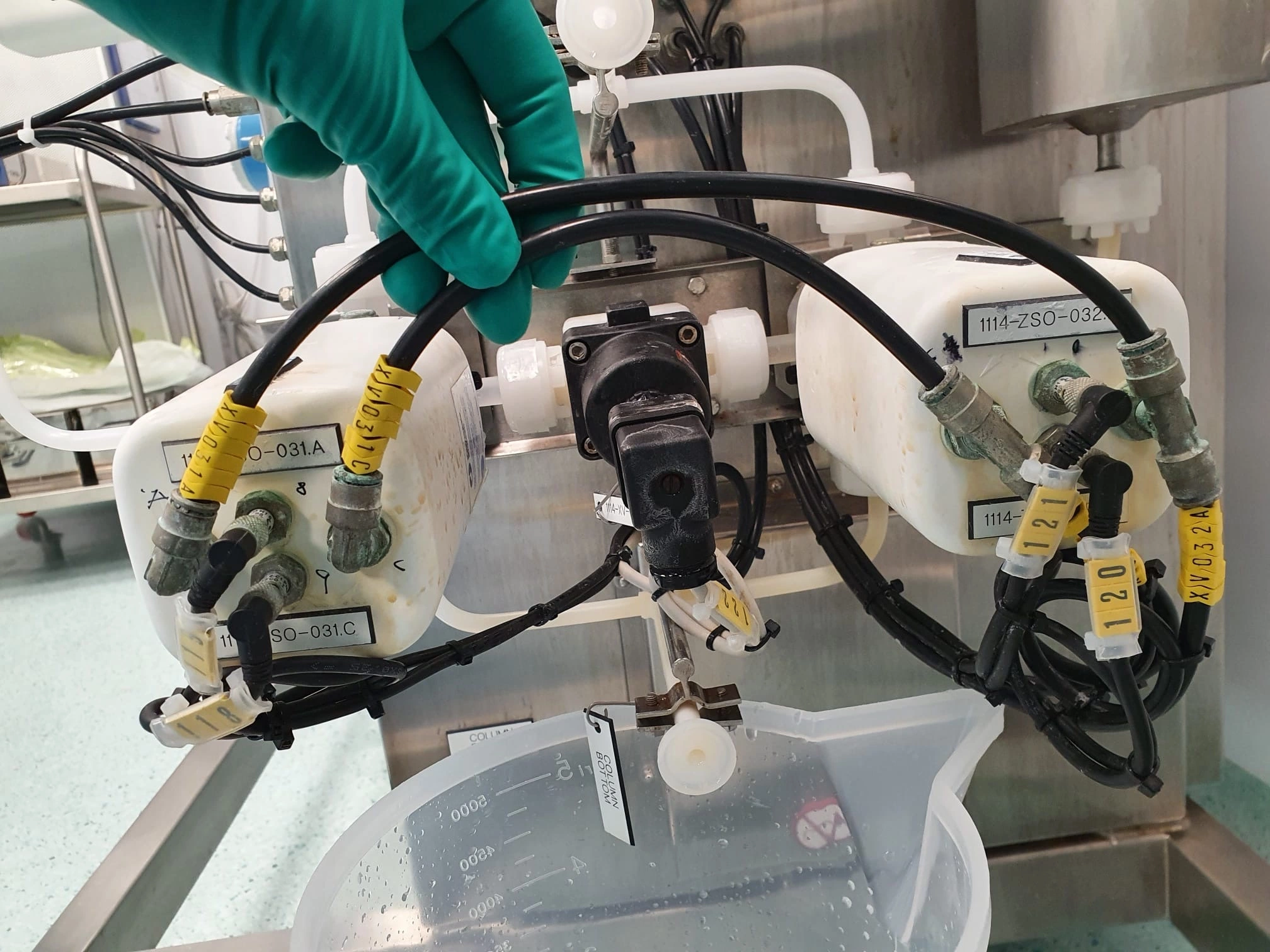
The afternoon before a nighttime run is no time for a system error. Working quickly, a remote service engineer helped a GMP-compliant biopharmaceutical manufacturing customer track down the problem – a company staffer reversed two sensor wires during routine maintenance. The issue was quickly solved, and the manufacturing step ran as scheduled. Here’s a photo of the issue:
Case study: A customer’s system stopped mid-run
With product on the column, there was no time to waste in resolving a system error. With remote services enables, a remote service engineer, who had trained the company’s maintenance engineer, was able to use remote tools to guide the engineer through the cause and fix – replacing a power supply. The run resumed, and the batch was saved.
Case study: An Italian company faced a tough call
An Italian-based biotech company, was experiencing system errors on their chromatography instrument—a different one each time—during production. Engineers in Italy and Russia teamed up using remote software to help the customer find the issue and solve it the same day. No flights. No wait. Just quick thinking and remote tools.

Tips to work smarter with digital tools
- Invest in digital service platforms to help you act quickly when needed.
- Train staff on remote diagnostics and troubleshooting protocols.
- Build a support roadmap that includes escalation paths and service level agreements.
Learn more about remote services
Plan ahead for critical spare parts
In the biopharma industry, where precision and uptime are paramount, spare parts planning can make or break operations. Ordering right before you need a part is risky – you might not be able to get it in time, which can shut down production. That’s bad for business and patients.
To stay ahead, companies are looking at new ways to manage their spare parts. With advisory notices, teams can anticipate component wear and plan to replace parts before there’s an issue. With OEM or custom parts, you can make sure they’re compatible and meet high quality standards. Robust inventory planning helps to reduce the risk of stockouts. It also ensures the right parts are held in the right quantities so that funds are not tied up in parts on-site that are not needed. By aligning spare parts logistics with production goals, you can reduce downtime, stay compliant with regulatory guidance, and keep therapies moving forward.
Tips to have parts on-hand when you need them
- Review advisory notices regularly to plan ahead for needed parts.
- Maintain an inventory of key spare parts for critical equipment.
- Align spare parts planning with preventive maintenance schedules.
Learn more about spare parts advisory service
Qualification and compliance
In current good manufacturing practices (cGMP) environments, compliance is a must – and that includes equipment. Systems need to be qualified when they’re installed. They also must be requalified after preventive maintenance, repairs, and when regulatory or environmental standards evolve. If they’re not requalified on time, companies risk falling out of compliance. The result could be costly delays, regulatory scrutiny, or even product recalls. It’s tough to stay on top of these complex requirements, especially when there are multiple systems and timelines to manage.
To meet these challenges, adopting formal strategies for qualification and requalification are becoming more commonplace. Doing this task online makes it easy to document and validate processes. Manual errors go down, and readiness speeds up. These digital tools also provide traceable records that are ready for audits. By making qualification part of your routine, you can make sure that your equipment consistently performs within validated parameters – which supports both compliance and product integrity.
Case study: A biotech hub in Latin America kept going strong
cAfter a brief pause at the start of the pandemic, this biotech hub in Latin America got back to business. The temporary shutdown meant that requalification services were needed to keep their 70 instruments compliant and running smoothly – with installations, qualifications (IQOQs), preventive maintenance, and corrective maintenance. Having a service partner on-hand to support with this mammoth task was necessary to keep pace with production schedules.
Tips to support quality and compliance
- Schedule requalification services after preventive maintenance or repairs.
- Validate equipment in its actual operating environment.
- Document all qualification activities to support regulatory audits.
Learn more about qualification services
Focus on the future: prevent, detect, and train
By being proactive and making efforts to self-serve—for example, scheduling preventive maintenance and training staff— can help your teams avoid costly downtime. Scheduling preventive maintenance and aligning it with spare pares planning helps biopharma teams avoid costly downtime and stay compliant. Training staff to use remote diagnostics and troubleshoot confidently empowers teams to resolve issues faster and maintain operational resilience.
How can we help you
One size doesn’t fit all in biopharma. That’s why we work side-by-side with teams to shape service plans that match their pace and align with guidelines. Whether you’re scaling up or racing the clock, this close teamwork will help you stay on track − no stops, no slips, just smooth and steady progress.
We invite you to engage with our dynamic service ecosystem − designed to support compliance and keep unplanned downtime to a minimum. Tap into our support and tailored solutions that empower long-term success.