Chromatography terminology
A
Adapter
Used for the movable end pieces of columns. It contains a filter and flow distributor, and can be used to connect tubing.
Adsorption binding
The process of interaction between the solute (e.g., a protein) and the stationary phase.
Affinity chromatography
A group of methods based on various types of specific affinities between target molecule(s) — for example, a protein and a specific ligand coupled to a chromatography resin.
Asymmetry Factor (AS)
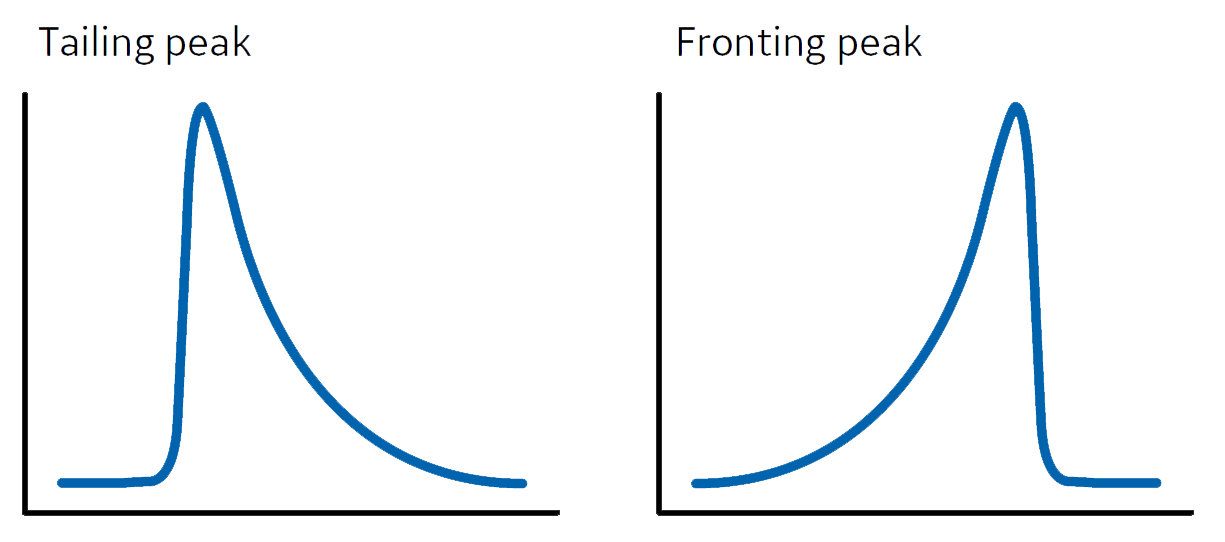
Factor describing the shape of a chromatographic peak. Measured at a defined height of the peak; can be at the base (between tangents drawn) or at 5% or 10% of the actual peak. Peaks are known as tailing when As > 1.0 and fronting when As < 1.0. Gaussian peaks are defined as As = 1.0.
B
Backpressure
The pressure drop across a column and/or a chromatography system.
Band broadening
The widening of a zone of solute (e.g., a protein) when passing through a column or a chromatography system. Leads to dilution of the solute and reduced resolution. Also often called peak broadening or zone broadening.
Bed volume
Volume of the resin bed that the adapter compresses and locks in place.
Binding adsorption
The process of interaction between a solute (e.g., a protein) and the stationary phase.
Binding buffer
Buffer, solution, or eluent used to equilibrate the column before sample loading.
Binding capacity
The maximum amount of material that can bind per milliliter of chromatography resin. See also dynamic binding capacity.
C
Capacity factor
The degree of retention of a solute (e.g., a protein) relative to an unretained peak.
Chromatofocusing
Method that separates proteins based on pI.
Chromatogram
A graphic presentation of detector response(s) that indicates the concentration of the solutes coming out of the column during the purification, expressed in volume or time.
Chromatography
From Greek chroma, color, and graphein, to write.
Chromatography resin
The stationary phase. The chromatography resin is composed of a porous matrix that is usually functionalized by coupling ligands to it. The matrix is in the form of particles or, rarely, a single polymer block (monolith).
CIP
Cleaning-in-place (CIP) is a common term for cleaning chromatography columns and/or systems to remove any unwanted or nonspecifically bound material.
Column
Usually refers to column hardware packed with chromatography resin.
Column equilibration
Passage of buffer or solution through the chromatography column to establish good binding conditions for the selected sample components. For example, column equilibration can establish the correct pH and ionic strength, and ensure that proper counter ions or counter ligands are present.
Column hardware
The column tube and adapters. Refers to all pieces of the column except for the chromatography resin and the packed bed.
Column hardware pressure
The pressure inside the column. Column hardware pressure that is too high can break the column.
Column packing
Controlled filling of the column hardware with chromatography resin compressed to a certain, predefined extent to achieve a stable particle bed.
Column volume
The geometrical volume of the column interior.
Counter ion
Ion of opposite charge that interacts with an ion exchange chromatography resin after the column equilibration. A protein that binds to the ion exchanger displaces the counter ion. If you apply a high concentration of the counter ion, it will compete with the bound protein and elute it from the chromatography column.
Counter ligand
Substances that interact with ligands of a chromatography resin and can be displaced by a solute (e.g., protein) binding to the ligand.
D
Dead volume
The volume in a chromatography system, from the injector to the detector, not including the column volume. Dead volume contributes to band broadening.
Degassing
Removal of dissolved air from buffers and solutions.
Desorption elution
Release or removal of bound substances from the chromatography resin.
Design of experiments
Design of experiments (DoE) allows use of a minimum number of experiments, where scientists can vary several experimental parameters simultaneously. Based on the obtained data, you can create a mathematical model of the studied process (e.g., a protein purification protocol or a chromatography step). Then you can use the model to understand the influence of the experimental parameters on the outcome and to find an optimum for the process.
Dynamic binding capacity
E
Efficiency (and efficiency test)
High efficiency means that the band broadening is low, and that you’ll obtain sharp peaks. It’s often given as the number of theoretical plates (N) or as theoretical plates per meter (N/m) to an independent measure of column length in the experiment. Efficiency plays a central role in qualifying and monitoring packed bed performance. The ideal high column efficiency gives low band and peak broadening, and indicates how well packed the column is before starting purification.
Column efficiency is typically defined using two parameters:
- Peak broadening over the column is described by an equivalent number of theoretical plates.
- Peak symmetry is described by a peak asymmetry factor, As.
Each Cytiva resin protocol describes the procedure to determine column efficiency. You can also find it in our application note, Column efficiency testing.
Effluent
Mobile phase leaving the column, eluate.
Eluate
Mobile phase leaving the column, effluent.
Eluent
Buffer or solution used during chromatography, mobile phase.
Elution buffer
Buffer or solution used for elution (desorption) of bound solutes (e.g., proteins) from a column.
Elution volume
The volume of buffer or solution (eluent) required to elute the solute (e.g., a protein), known as the retention volume.
Elution time
The time required for elution of a solute (e.g., a protein), known as the retention time.
F
Flow rate
Volumetric flow (mL/min) or linear flow rate (cm/h). Measures flow through a column and/or chromatography system.
Flowthrough
Material that passes through the column during sample loading without binding.
Frit
A type of deep filter often used at top and bottom of columns.
G
Gel filtration
Gel filtration (GF) is size-exclusion chromatography. It separates solutes (e.g., proteins) according to size.
Gradient elution
Continuous increased or decreased concentration of a substance (in the eluent) that causes elution of bound solutes (e.g., proteins).
H
Hydrophobic interaction chromatography
Hydrophobic interaction chromatography (HIC) is a method based on the hydrophobic interaction between solutes (e.g., proteins) and the chromatography resin in the presence of high salt concentration.
Hydroxyapatite chromatography
Mixed-mode ion exchange chromatography method.
I
Immobilized metal ion affinity chromatography
Immobilized metal ion affinity chromatography (IMAC) is a method based on the affinity of proteins with His, Cys, or Trp amino acid residues on their surface and metal ions on the chromatography resin.
Ion exchange chromatography
Ion exchange chromatography (IEX) is a method based on electrostatic interactions between solutes (e.g., proteins) and chromatography resin.
Isocratic elution
Elution of the solutes without changing the composition of the buffer or solution (eluent).
L
Ligand
The specific molecular group that couples to the matrix to functionalize the chromatography resin.
Ligand density
Related to ligand concentration. The distribution of ligands on the surfaces (including the surfaces inside pores) of the chromatography matrix.
Linear velocity
The flow rate normalized by the column cross section (cm/h).
M
Mass transfer
Movement of a solute (e.g., a protein) in and out of the stationary phase. Mass transfer is an important factor for column efficiency.
Matrix
The matrix is the nonfunctional base for the chromatography resin. The matrix has a porous structure and large surface area that you can modify with ligands to enable protein binding.
Mobile phase
The fluid (buffer or solution) carrying the solutes during chromatography. Can also be referred to as the eluent.
P
Particle size (dp)
The mean diameter of the spherical beads.
Peak broadening
Same as band broadening.
Peak capacity
The number of peaks that you can separate using a chromatography column.
Peak fronting
Broadening at the beginning of a peak. Results in decreased asymmetry factor.
Peak tailing
Broadening at the end of a peak due to additional delay of a fraction of the solute. Results in increased asymmetry factor.
Plate number (N)
A measure of chromatography peak broadening and column efficiency. Also referred to as the number of theoretical plates. Scientists use the plate number of a column to measure column efficiency. The more plates a packed column has, the higher the column efficiency.
The plate number is calculated from N = 5.545 × (VR/Wh)2 assuming a Gaussian peak, where:
- VR = retention (elution) volume
- Wh = peak width at half peak-height.
VR and Wh must have the same unit (e.g., mL). You can substitute VR with retention time, tR, but then the unit of Wh must be time.
Pore
Cavity in a chromatography matrix.
Pore volume
The total volume of the pores in a chromatography resin.
Pressure over the packed bed
The pressure drop across the packed bed when solution passes through the column. Caused by flow resistance in the packed bed.
R
Recovery
The amount of target protein retrieved after purification relative to the amount loaded on the column.
Resolution
Measures the ability of a packed column to separate two solutes (peaks).
Residence time
The time a buffer or solute spends in the column.
Retention volume
Same as elution volume.
Retention time
Same as elution time.
Reversed phase chromatography
Reversed phase chromatography (RPC) is a method based on hydrophobic interactions between solutes (sample components) and ligands coupled to the chromatography resin. Scientists use organic modifiers (e.g., acetonitrile) in the eluent for elution.
S
Sample
The material to be analyzed, or the material loaded on the chromatography column or resin.
Sample application
Applying and loading sample on the column.
Sample loading
Same as sample application.
Sample volume
The volume of the sample loaded on the chromatography column or resin.
Selectivity
Measures the relative retention of two solutes in a column. Related to the distance between two peaks.
Solute
The dissolved substance (e.g., a protein).
Static binding capacity
Binding capacity determined at equilibrium by batch experiment.
Stationary phase
Often called resin, chromatography particles, chromatography material, or chromatography medium or media.
Step gradient elution
Stepwise increase in concentration of the substance that affects elution of bound solutes.
T
Theoretical plate number
See plate number.
Theoretical plate numbers per meter (N/m)
Theoretical plate numbers per meter. A high value indicates a well packed bed. This value is used to compare columns packed with resins with the same particle size.
V
Void volume
The elution volume of solutes that don’t enter the pores or interact with the chromatography resin, and pass between the particles in the packed bed.
W
Wash
Refers to the wash step, when scientists remove any unbound or weakly bound material from a column after the sample loading.
Wash buffer
Buffer or solution used for washing the column after sample loading.
Wash volume
Volume of buffer or solution used for the wash step.
Y
Yield
Amount of target protein (or other solute) obtained after a purification step, or after the entire purification (multiple steps).
Z
Zone broadening
Same as Band broadening.