Introduction
Conventional reusable mixers are commonly used to create a homogeneous sorbent slurry prior to packing of chromatography columns. As the popularity of single-use mixers has grown, so has interest in using them for such sorbent slurry mixing applications. In this study, a 50 L Wand Mixer single-use mixing system was evaluated for its ability to produce a homogeneous sorbent slurry.
Materials and methods
Mixing before automated packing
Before use, the 50 L Wand Mixer system was measured and photographed to establish baseline dimensions.
A 50 L Wand Mixer biocontainer was installed in a 50 L Wand Mixer round MDPE tank, inflated with air through a top inlet, then connected to a floor-based Wand Mixer drive unit. A T-piece with sampling port was then installed on the mixing biocontainer’s bottom drain outlet tubing to allow representative samples to be taken.
The sorbent slurry used in this study consisted of the 64% Q Sepharose™ XL resin in water. The Wand Mixer drive head was lowered until the sweeper was 5 cm from the bottom of the biocontainer, then mixing was initiated at a speed of 100 rpm. Slurry was then transferred to the mixing biocontainer using a diaphragm pump and tubing routed through the biocontainer’s powder port. After ~ 20 L of slurry had been transferred, the mixing speed was increased to 150 rpm, then pumping continued until ~ 40 L of slurry had been transferred—in total, this transfer took ~ 5 min. Mixing was continued at 150 rpm for 5 min after transfer was complete. Slurry was then sampled from the top (through the powder port) and bottom (at the T-piece) of the mixing biocontainer to confirm homogeneity.
With the powder port open to the atmosphere and the impeller continuing to run at 150 rpm, the slurry was transferred from the mixing biocontainer to a 400 mm automatically packing chromatography column via a diaphragm pump. At the conclusion of the draw, the mixing wand was found to be no longer in contact with the slurry. Lastly, the slurry was sampled from the bottom (at the T-piece) of the mixing biocontainer to confirm homogeneity.
For all samples taken, 10 mL aliquots were centrifuged at 1000 × g for 2 × 5 min then quantitated by measurement of the solid bed height.
Mixing after automated unpacking and settling
Mixing in the Wand Mixer was resumed at 150 rpm. The slurry was resuspended inside the column through an introduction of air from the bottom of the column, then the column was drained back into the mixing biocontainer via a top inlet port. An automated rinse of the column with a further 7 L of water was performed to ensure all the sorbent had been returned to the Wand Mixer, resulting in a dilution of the sorbent to a concentration of ~ 58%.
Once transfer to the Wand Mixer was complete, mixing was stopped, and the sorbent was allowed to settle overnight (16 to 18 h—deemed to be a worst-case scenario). Resuspension was then assessed by resuming mixing at incrementally increasing impeller speeds; 30 rpm for 1 min, then 50 rpm for 1 min, then 100 rpm for 1.5 min, and finally 150 rpm for 5 min. Slurry was then sampled from the top (through the powder port) and bottom (at the T-piece) of the mixing biocontainer to confirm homogeneity.
For all samples taken, 10 mL aliquots were centrifuged at 1000 × g for 2 × 5 min then quantitated by measurement of the solid bed height. After use, the 50 L Wand Mixer system was measured and photographed to assess whether deformation had occurred.
Results
Pre-packing mixing efficiency results are given in Table 1. Figure 1 shows typical sample appearance in centrifuge tubes after centrifugation. Post-unpacking/post-settling mixing efficiency results are given in Table 2.
Table 1. Slurry concentration before column packing and after 5 min mixing at 150 rpm
| Reference1 |
After 5 min mixing at 150 rpm |
At the end of the slurry draw |
|||
|---|---|---|---|---|---|
| Sampling level | N/A |
Samples from the top |
Samples from the bottom |
Samples from the bottom |
|
| Average slurry concentration (%) | 64.1 |
65.3 |
65.6 | 63.9 |
|
1 The reference is based on collected data from the slurry after manual mixing.
During pre-packing mixing, the sorbent slurry was found to be homogeneous after 10 min (5 min transfer followed by 5 min of post-transfer mixing at 150 rpm) and remained homogeneous until the end of the slurry draw, even though the wand was no longer in contact with the slurry.
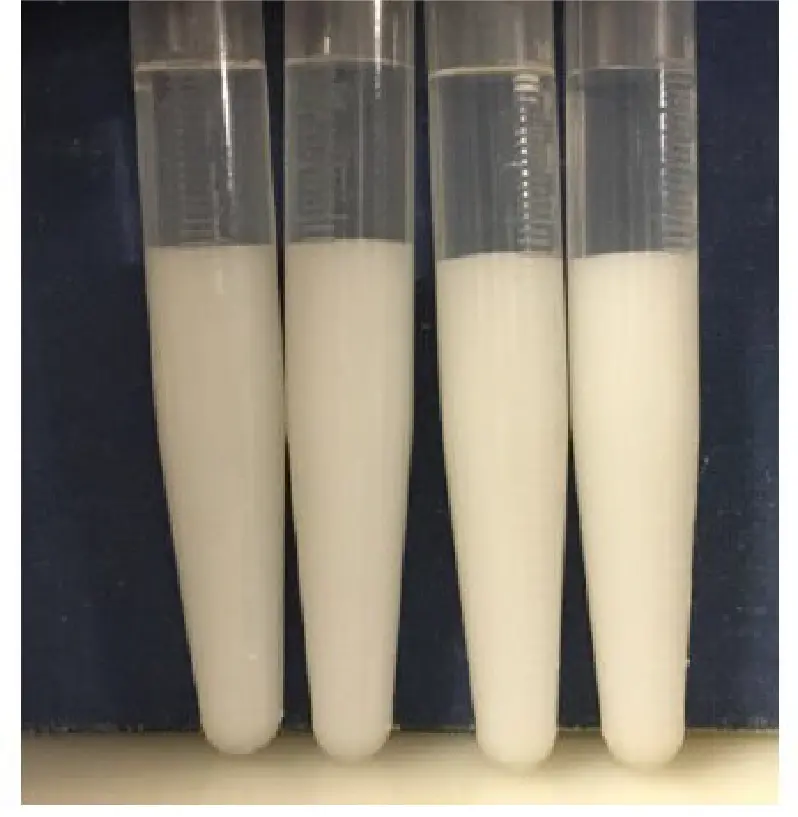
Fig 1. Samples from the top (left two tubes) and the bottom (right two tubes) of the mixing bag after 5 min mixing and 2 × 5 min centrifugation.
Table 2. Sorbent concentrations after one night settling and 8.5 min mixing from 30 to 150 rpm
| Reference1 |
After 8.5 min mixing from 30 to 150 rpm |
|||
|---|---|---|---|---|
| Sampling level | N/A |
Samples from the top |
Samples from the bottom |
|
| Average sorbent concentration (%) | 58.0 |
57.1 |
56.4 | |
1 The reference is based on collected data from the sorbent after manual mixing.
During post-unpacking/post-settling mixing, the sorbent slurry was found to be homogeneous after 8.5 min mixing in increments from 30 to 150 rpm. The shape and dimensions of the mixing wand were evaluated (Fig 2). No changes in dimensions or appearance were noted, confirming that the forces experienced during the mixing study did not over-stress the wand, even when mixing was initiated while its lower section was fully immersed in the sorbent bed.
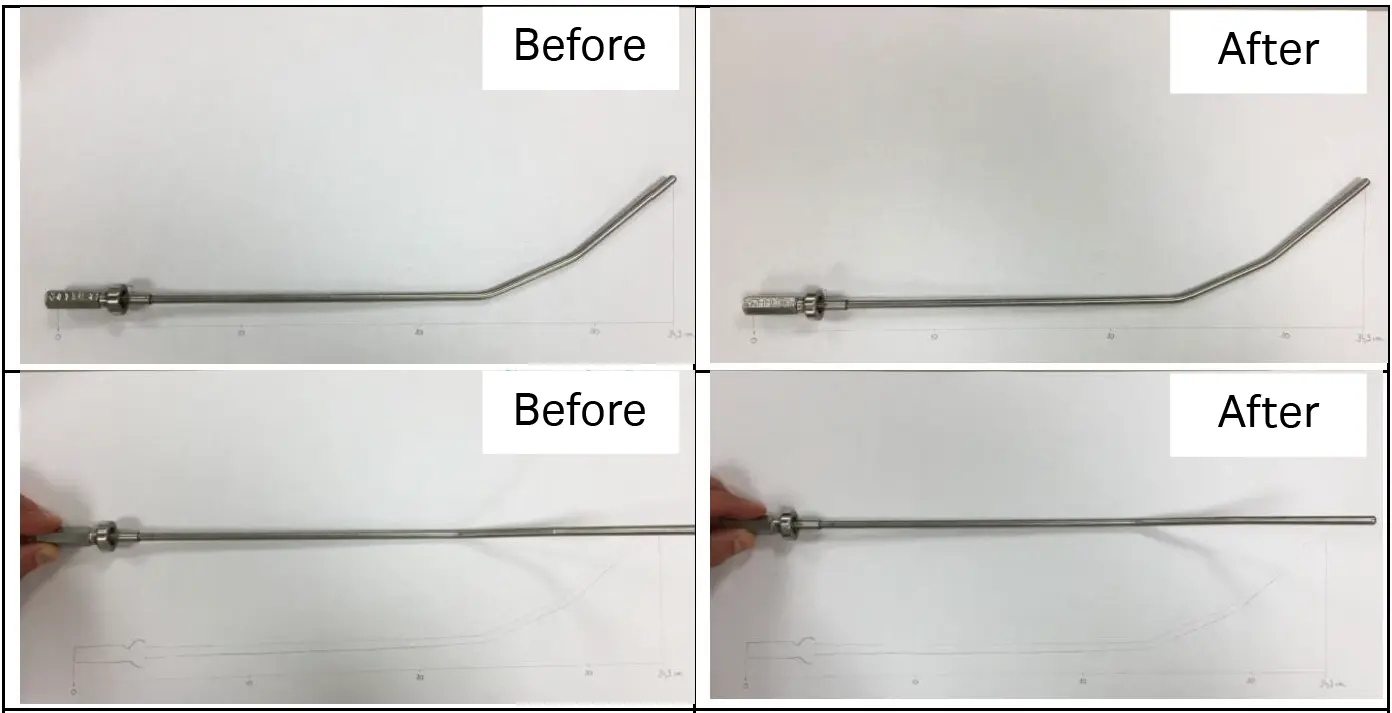
Fig 2. Mixing wand before and after study.
Recommendations
The tubing leading in and out of the biocontainer should be checked to ensure it is free of kinks before initiating the automated packing and unpacking sequences.
Not more than 0.4 bar (5.8 psi, 0.04 MPa) static pressure should be applied to the bottom drain line during the slurry vessel air agitation before packing.
The mixing biocontainer should be properly vented to avoid over-pressurization during air agitation and column unpacking. The maximum operating pressure of a mixer biocontainer is 0.4 bar (5.8 psi, 0.04 MPa). We recommend using an inflation box for a controlled pressure environment of the biocontainer. More information can be obtained by contacting your local Cytiva contact person.
Conclusions
The 50 L Wand Mixer system is able to create a homogenous 64% Q Sepharose XL sorbent slurry in less than 10 min before column packing, and again after column unpacking with an overnight settling period.
The mixing procedure of incrementally increasing mixing speed from 30 to 150 rpm over 8.5 min provided safe and efficient mixing with no damage to the mixing wand. We recommend using this procedure to create a homogenous slurry with the Q Sepharose XL and similar sorbents.
CY59906