Packing a chromatography column is an art in itself and requires a certain level of expertise. Here, we provide definitions for common terminology used in column packing.
A
Asymmetry Factor (AS)
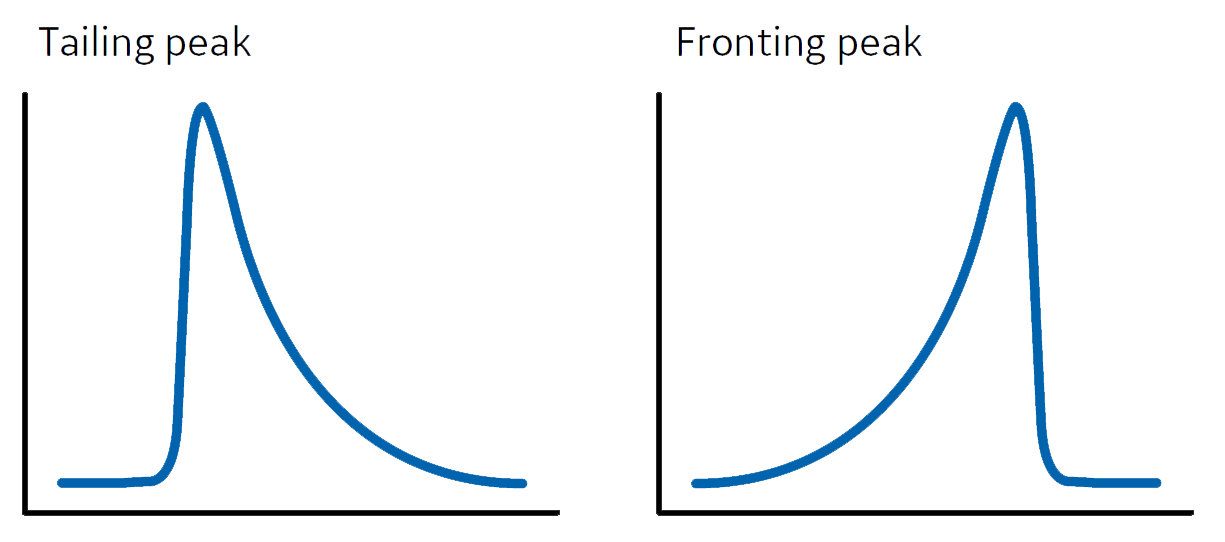
Factor describing the shape of a chromatographic peak. Measured at a defined height of the peak; can be at the base (between tangents drawn) or at 5% or 10% of the actual peak. Peaks are known as tailing when As > 1.0 and fronting when As < 1.0. Gaussian peaks are defined as As = 1.0.
Adapter
Used for the movable end pieces of columns. It contains a filter and flow distributor, and can be used to connect tubing.
B
Backpressure
The pressure drop across a column and/or a chromatography system.
Band broadening
The widening of a zone of solute (e.g., a protein) when passing through a column or a chromatography system. Leads to dilution of the solute and reduced resolution. Also often called peak broadening or zone broadening.
Bed volume
Volume of the resin bed that the adapter compresses and locks in place.
C
Column holder
Specially designed device that could be attached to the system or a stand to hold the column in a vertical position.
Column packing
Controlled filling of the column hardware with chromatography resin compressed to a certain, predefined extent to achieve a stable particle bed.
Column volume
The geometrical volume of the column interior.
Compression (mechanical and flow compressions)
Depending on the column type and resin, the compression may be performed in two different ways:
Mechanical compression with packing factor:After applying the settling flow, note the height of the consolidated bed before stopping the flow (after the flow is stopped the bed can slightly expand). The final bed height is calculated by dividing the consolidated bed height with the packing factor (PF):
Final bed height = Consolidated bed height/packing factor (PF).
Set the adapter against the consolidated packed bed, tighten the O-ring, and turn the end cap down until the calculated final bed height is reached.
Flow compression:After applying the packing flow, the adapter is moved a specific distance (mm) into the packed bed to avoid gap formation.
Compression factor (CF)
CF is defined as the settled bed height (bed height measured after settling by gravity, L settled) divided by the packed bed height (Lpacked), that is, CF=L settled/ Lpacked
Consolidated bed height (Lconc)
The pressure at the critical velocity.
Critical pressure (Pcri)
Usually refers to column hardware packed with chromatography resin.
Critical velocity (Vcri)
The highest velocity possible to obtain in an open bed. The procedure to determine Vcri is described in Development of column packing methods based on pressure-flow measurements
E
Efficiency (and efficiency test)
High efficiency means that the band broadening is low, and that you’ll obtain sharp peaks. It’s often given as the number of theoretical plates (N) or as theoretical plates per meter (N/m) to an independent measure of column length in the experiment. Efficiency plays a central role in qualifying and monitoring packed bed performance. The ideal high column efficiency gives low band and peak broadening, and indicates how well packed the column is before starting purification.
Column efficiency is typically defined using two parameters:
- Peak broadening over the column is described by an equivalent number of theoretical plates.
- Peak symmetry is described by a peak asymmetry factor, As.
Each Cytiva resin protocol describes the procedure to determine column efficiency. You can also find it in our application note, Column efficiency testing application note.
F
Flow compression
See Compression.
H
Height Equivalent to a Theoretical Plate (HETP)
Height Equivalent to a Theoretical Plate (HETP), is a measure of column efficiency denoted as H and is usually reported in millimeter. HETP is calculated from H = L/N, where L=length of column and N= number of theoretical plates. The shorter each theoretical plate of the packed column, the more plates are "contained" in any length of column. This, of course, translates to more plates per meter and higher column efficiency.
M
Mechanical compression
See Compression.
O
Open bed
A bed that has a liquid head space between the bed surface and the adapter.
Operational pressure (Pop)
The pressure at the critical velocity.
Operational velocity (Vop)
The maximum velocity possible to use in a packed bed.
P
Packed bed
A bed that is compressed and locked in place by the adapter.
Packing connector
Connects two chromatography columns with each other allowing one of them to be used as packing reservoir.
Packing factor (PF)
PF is defined as the consolidated bed height (bed height measured after settling a resin at a given flow velocity, L conc) divided by the packed bed height (Lpacked), that is, PF=L conc/ Lpacked.
Packing pressure (ppac)
The pressure at the packing velocity.
Packing reservoir
A cylindrical container with a diameter larger than the column which can be connected to the chromatography column when packing the resin.
Packing solution
The preferred term for describing the solution for column packing, as opposed to packing buffer (since a buffer related to pH is not necessarily used for column packing).
Packing tube
A cylindrical tube or column with the same diameter as the column which can be connected to the chromatography column when packing the resin.
Packing velocity (Vpack)
The suitable velocity for packing a bed to the correct compression.
Particle size (dp)
The mean diameter of the spherical beads
Peak broadening
See Band broadening.
Plate number (N)
A measure of chromatography peak broadening/column efficiency. Also referred to as number of theoretical plates. The plate number of a column is used to measure column efficiency. The more plates a packed column has, the higher the column efficiency. The plate number is calculated from N = 5.545 × (VR/Wh)2 assuming a Gaussian peak, where VR = retention (elution) volume and Wh = peak width at half peak-height. VR and Wh must have the same unit (e.g., mL). VR may be substituted in the formula with retention time, tR, but then the unit of Wh must be time.
See also Plate height/height equivalent to a theoretical plate and Reduced plate height. See Efficiency as well.
Plate height/height equivalent to a theoretical plate (H)
Height Equivalent to a Theoretical Plate (HETP) is a measure of column efficiency denoted as H and is usually reported in millimeter. HETP is calculated from H = L/N, where L=length of column and N= number of theoretical plates. The shorter each theoretical plate of the packed column, the more plates are "contained" in any length of column. This, of course, translates to more plates per meter and higher column efficiency.
Pulse test
A small volume of a tracer substance (i.e. acetone or NaCl) is added to the liquid flow close to the column inlet and the broadening of this pulse is analyzed when measured as a chromatographic peak at the column outlet. Used to test column efficiency.
R
Reduced plate height (h)
Reduced plate height is a normalization of the efficiency based on the average particle diameter (dp) of the resin. This makes it possible to compare efficiency for packed bed between different resins. It is dimensionless and thus convenient parameter for efficiency characterization. This parameter facilitates the comparison of column efficiency irrespective of column length and particle diameter of the resin. The reduced plate height is calculated from h = HETP/dp, where HETP is the Height Equivalent to a Theoretical Plate and dp is the particle diameter of the chromatography resin. Optimal column efficiency typically corresponds to an experimentally determined reduced plate height of h ≤ 3 for the porous resin employed in bioprocess chromatography. This efficiency is achieved when testing a well-packed bed with an optimized set-up of column and system under optimal test conditions.
S
Settled bed height (Lsettled)
Bed height measured after setting by gravity.
Slurry (resin slurry): definition, concentration and packing amount
Resin slurry
Resin particles suspended in liquid.
Slurry concentration
The slurry concentration is used to facilitate the calculation of the amount or resin needed to pack a certain bed height. For successful packing, different resins require different slurry concentrations. To determine the slurry concentration for large columns (approx. > 5L), we recommend that you use the Slurry Concentration Kit. You can also watch our video Column packing tutorial: Determining slurry concentration using a slurry kit. For small columns, other methods involving centrifugation and/or sedimentation are also possible to use.
How to calculate the amount of resin slurry that is needed to pack a column?
Follow the following steps.
| Steps | Description of each step | Example: Packing Capto Q in an XK 16/20 column (10 cm bed height) |
|---|---|---|
| 1. Define the volume to take from the resin bottle (Vs). | The volume of the initial resin slurry1 to take from the bottle is calculated according to the following formula: Vs = (Vc/Cs) × CF where
|
According to packing instructions
So, 31 mL of the initial suspended slurry should be taken from the supplied resin bottle. |
| 2. Wash the initial resin slurry into the packing solution |
|
|
| 3. Adjust the slurry concentration |
|
|
T
Theoretical plate number
A measure of chromatography peak broadening/column efficiency. Also referred to as number of theoretical plates. The plate number of a column is used to measure column efficiency. The more plates a packed column has, the higher the column efficiency. The plate number is calculated from N = 5.545 × (VR/Wh)2 assuming a Gaussian peak, where VR = retention (elution) volume and Wh = peak width at half peak-height. VR and Wh must have the same unit (e.g., mL). VR may be substituted in the formula with retention time, tR, but then the unit of Wh must be time.
See also Plate height/height equivalent to a theoretical plate and Reduced plate height. Also see Efficiency.
Theoretical plate numbers per meter (N/m)
Theoretical plate numbers per meter. A high value indicates a well packed bed. This value is used to compare columns packed with resins with the same particle size.
Z
Zone broadening
Same as Band broadening.