This study compares protein A affinity chromatography with a vacuum-operated AcroPrep™ 24-well filter plate format for IgG purification by filtration. Using identical resin bed volumes and model IgG loads, the filter plate approach achieved significantly higher IgG recovery. We show that efficient IgG binding and recovery can be achieved with substantially shorter incubation times under vacuum for faster protein purification. Overall, the AcroPrep 24-well filter plate provides a robust, high-throughput alternative to column-based methods, making it well-suited for rapid clone screening, resin evaluation, and early stage upstream/downstream process development.
Introduction
Large-scale bioprocessing of recombinant proteins such as monoclonal antibodies (rmAbs) in the biopharmaceutical industry is a lengthy process that requires the use of a combination of different chromatographic techniques for protein purification (1,2). Most often, rmAbs are expressed into the culture media by engineered cell lines and the rmAb recovery process starts with the removal of cells and cell debris by filtration or centrifugation. A typical chromatography process may consist of:
- An initial capture step employing protein A or protein G-based affinity chromatography to obtain the rmAbs from the clarified media.
- An intermediate step using ion exchange chromatography.
- A final polishing step using a bind and elute process involving hydrophobic interaction, mixed-mode or hydroxyapatite chromatography before concentration and diafiltration into the formulation buffer.
An rmAb is often derived from a common framework having a high degree of homology, which enables the establishment of a platform technology for purification of similar molecules with minimal process alteration.
Chromatography also plays an important role in the initial process of clone development of rmAb expressing cell lines, which can start with the screening of hundreds of clones to identify high producing cell lines that can be used for large-scale production. Despite technological advances, gravity-based affinity separation in individual columns remains a typical choice in many laboratories. Simultaneous screening of clarified media from multiple cell lines under these conditions can be quite challenging and time consuming as it involves the handling and manipulation of multiple individual columns and collection vessels that depend on gravity to flow liquid through the chromatography resin.
We describe the implementation of AcroPrep 24-well filter plates with 1.2 µm Supor™ membrane for affinity purification where processing is driven by a vacuum manifold. The main objective of this study was to understand how the overall yield is affected by a reduced incubation time. A column-based method was also included as a benchmark in all experiments.
Materials and methods
Two affinity chromatography experiments employing immobilized protein A resin (G-Biosciences) for the purification of human Immunoglobulin G (IgG) from a model sample load were carried out. In both experiments, one arm employed the traditional gravity-based column method whereas the other arm employed a vacuum-mediated filter plate method.
The first experiment examined IgG recoveries for both chromatography methods after a model sample load containing 10 mg of IgG protein and was carried out with 10 replicates for each processing method.
Table 1 provides the incubation times that were implemented for each process step for both methods. The second experiment assessed the process recovery without any incubation time upon loading increasing amounts of protein. This experiment was carried out in triplicate for each loaded amount of IgG protein (6, 10, and 14 mg, respectively) for both the traditional gravity-based column and the vacuum-mediated filter plate methods.
Table 1. Purification process steps and incubation time
| Incubation time (min) |
||||
|---|---|---|---|---|
| Process step | Volume (mL) | Disposable plastic column with G-Biosciences protein A resin | AcroPrep 24-well filter plate | |
| Equilibration | 6 | 2 | 2 | |
| Load Incubation | 10 | 30 | 10 | |
| Wash | 6 | 3 | 2 | |
| Elution 1 | 1 | 30 | 13 | |
| Elution 2 | 2.3 | 45 | 5 | |
| Total process time (min) | 110 | 32 | ||
Purification of IgG with protein A resin
Resin packing
Chromatography purifications were performed with 0.5 mL bed volumes of immobilized protein A resin packed in individual disposable plastic columns or in individual wells of an AcroPrep 24-well filter plate with 1.2 µm Supor membrane. Packing was performed with a 50% slurry of immobilized protein A resin (G-Biosciences), which was prepared for use by washing multiple times with water to remove traces of ethanol. Aliquots (1 mL) of the washed resin slurry were then packed into the disposable plastic columns or into wells of the filter plate. For the filter plate, a vacuum of 2.5 in Hg was applied to pack resins in the filter plates using a multiwell plate vacuum manifold. Unused wells of the plate were covered with sealing film during vacuum application.
Sample/load preparation
For the first experiment, a model sample load was prepared by mixing 200 mg of human IgG (Millipore Sigma) in 160 mL of 1× phosphate buffered saline (PBS) (Millipore Sigma), which was then spiked with 40 mL of chemically defined EX-cell CD CHO serum-free medium for CHO cells (Millipore Sigma), to a final IgG concentration of 1 mg/mL. From the above-prepared stock, 10 mL were added to each packed column and well of the 24-well filter plate during the loading step. While loading the filter plate, two aliquots of 5 mL were added. The second aliquot was added only when the incubation time after the first addition was completed.
For the second experiment, a separate 2 mg/mL load of IgG was prepared in a similar fashion as previously described. Aliquots of 3, 5, and 7 mL of this IgG sample load were loaded in triplicate to packed columns and filter plate wells to achieve total IgG protein amounts of 6, 10, and 14 mg, respectively.
Purification procedure
We purified IgG either by gravity for the columns or vacuum mediated for the filter plate. For the filter plate, a vacuum of 2.5 in Hg was applied. After packing, the immobilized protein A resin in each well or column was equilibrated with 6 mL of 1× PBS, pH 7.4.
The pH of the filtrate/eluate was checked using a pH strip and samples were only loaded once the equilibration eluate was at neutral pH. A wash with 6 mL of 1× PBS, pH 7.4 then followed, after which we eluted the IgG from the column by successive addition of 1 and 2.3 mL aliquots of 100 mM glycine-HCl buffer, pH 3.0. The pH strip method was used to ensure that the pH of the eluate was low. Post-elution, the eluate was neutralized by adding 200 µL of 1 M Tris, pH 8.0.
The pH of neutralized elute was checked using a pH strip. This process is further described in Table 1, which also indicates the incubation times at each step for both the gravity-based column method and the vacuum-mediated filter plate method. During incubations, we capped the column tips to prevent elution.
The filter plates required no additional handling as only minimal weeping was observed during incubations. Process time for purification was measured as average cycle time without accounting for the time of sample loading or pipetting of solutions, as these were considered roughly equal for both methodologies.
Protein quantitation
We performed protein quantitation by measuring the absorption at a wavelength of 280 nm (A280) with a BioSpectrometer (Eppendorf) and calculating the concentration according to the Beer-Lambert law.
The concentration was calculated by multiplying the absorbance to the specific absorption coefficient factor specific for pure IgG (F):
Concentration (mg⁄mL) = A280 × F
Total recovery was calculated using the following equation:
Recovery (%) = 100 × Mrecovered / Mloaded
where:
Protein content (M) = concentration (C) × volume (V)
Results and discussion
Process recovery with and without incubation
Figure 1 indicates that the process recoveries for the vacuum-mediated filter plate method were approximately two-fold greater when compared to gravity-based purification. We calculated the process recovery based on the equation provided in the method section. The observations could possibly be associated with the interaction between protein A and IgG under various test conditions (vacuum applied in an AcroPrep 24-well filter plate vs gravity interaction in disposable plastic columns).
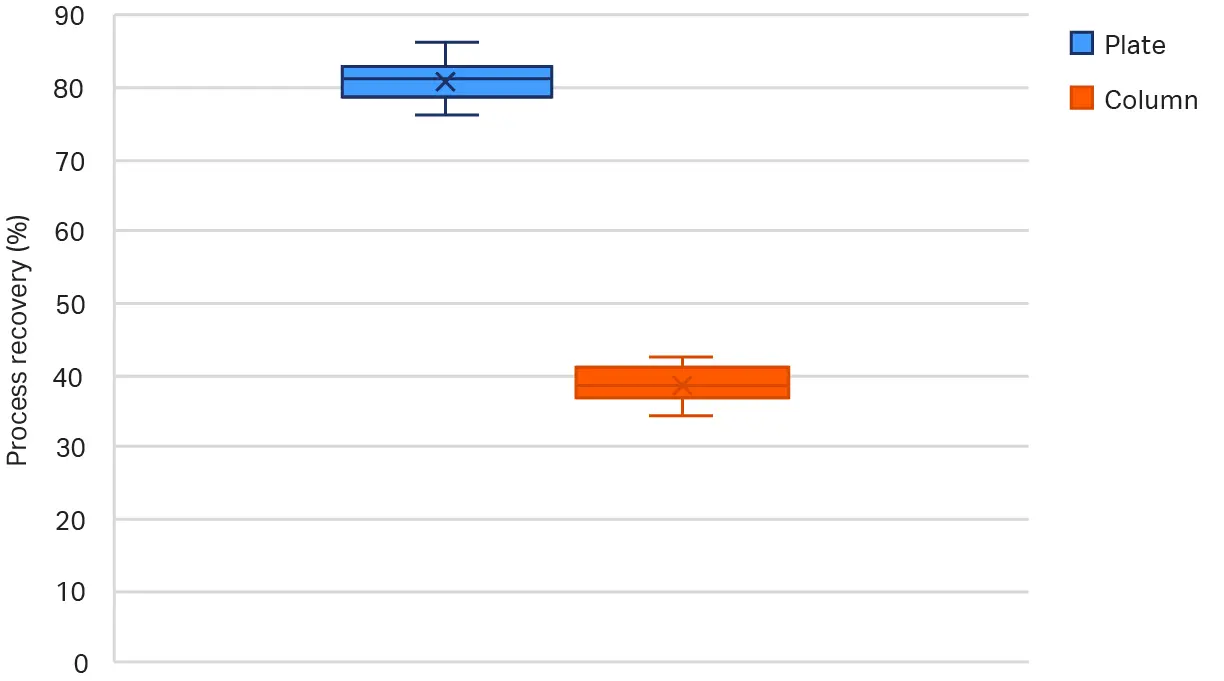
Fig 1. Process recovery of 10 replicates from AcroPrep 24-well filter plates and G-Biosciences protein A-packed disposable plastic columns. We loaded IgG samples (10 mL of 1 mg/mL) samples into each disposable column and well of the AcroPrep 24-well plate containing 50% slurry of protein A resins. Purification was aided by vacuum and gravity for the AcroPrep 24-well filter plates and disposable plastic columns. Recovery was calculated per the equation mentioned in the method section. Data is mean ± standard deviation (SD) of 10 independent measurements; p-value < 0.025 in Student’s two-tailed t-test with unequal variance.
In an independent experiment, IgG recoveries were studied without any incubation time in the disposable plastic columns and AcroPrep 24-well filter plates. The objective was to estimate the minimum concentration which can be purified using protein A resins. Data obtained indicate that there is a decrease in IgG recovery with an increase in load quantity. The trend of a decrease in the IgG recovery under the conditions without incubation appears to be kinetically restricted resulting in saturation of binding at or above the 6 mg amount of input (3).
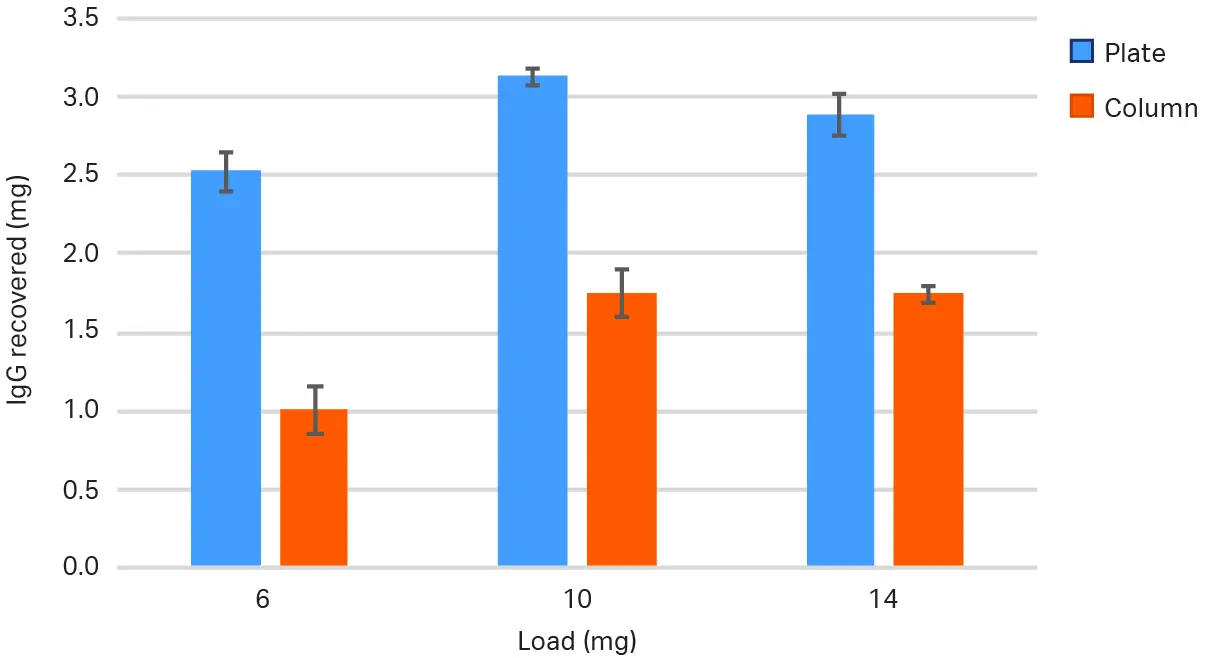
Fig 2. IgG recovery from disposable plastic columns and AcroPrep 24-well filter plate for different quantities of load. Loads of 6, 10, and 14 mg were used as total load and were purified either under vacuum in an AcroPrep 24-well filter plate or via gravity in plastic columns containing protein A resin. Data is mean ± SD of 10 independent measurements; p-value < 0.025 in Student’s two-tailed t-test with unequal variance.
Conclusion
In this study, we demonstrate use of AcroPrep 24-well filter plate as a tool to accelerate batch chromatography at laboratory scale.
The AcroPrep 24-well filter plate produced a higher recovery than column chromatography by employing a shorter incubation time, making the Acroprep 24-well filter plate an appropriate choice for resin screening, binding optimization, and elution condition studies in a downstream processing laboratory.
Additionally, the above study design can be applied to upstream process development laboratories where the assessment of culture characteristics (e.g., volumetric and specific productivity) and product quality attributes (e.g., aggregate levels) are routinely monitored to study the expression profiles of clones.
CY59685
References
- Chahar DS, Ravindran S, Pisal SS. Monoclonal antibody purification and its progression to commercial scale. Biologicals. 2020 Jan;63:1-13. doi: 10.1016/j.biologicals.2019.09.007. Epub 2019 Sep 23. PMID: 31558429.
- Li F, Vijayasankaran N, Shen AY, Kiss R, Amanullah A. Cell culture processes for monoclonal antibody production. MAbs. 2010 Sep-Oct;2(5):466-79. doi: 10.4161/mabs.2.5.12720. Epub 2010 Sep 1. PMID: 20622510; PMCID: PMC2958569.
- Mehta KK, Soderquist R, Shah P, Marchand N, Bolton GR. Comparing performance of new protein A resins for monoclonal antibody purification, American Pharmaceutical review 2018.