The industrial trend for fed-batch cell cultures is lower cultivation volumes with higher cell densities and mAb titers. However, this puts pressure on the clarification step to remove the increase in cells and cell debris. This is a challenge for midstream depth filtration and alternative depth filters may have to be considered for a process to satisfactorily remove fine particles.
With this in mind, we evaluated two different depth filter trains for clarification of a challenging, high cell density feed stream.
- Train 1: Stax™ mAx approach consisting of a primary PDP8 filter and secondary PDE2 filter, designed specifically for mAb harvest from CHO culture.
- Train 2: consisting of a primary PDK7 filter and secondary PDCX filter.
Both trains gave good results when clarifying high density fed-batch cell culture midstream.
As expected, the tighter depth filter of Train 2 generated a filtrate pool with a lower turbidity (3 to 4 NTU) compared to that of Train 1 (9 to 13 NTU), indicating more particles had been removed. However, Train 1 resulted in higher throughput.
Introduction
Our standard offering for processing mAbs is the Stax™ mAx option consisting of PDP8 (coarse) and PDE2 (fine) depth filters. This option (Train 1) has been evaluated in this study. A tighter depth filter combination (Train 2) consisting of PDK7 (coarse) and PDCX (fine) depth filters was also evaluated.
A small-scale study was performed using the chosen depth filter media in Supracap™ 50 depth filter capsules. These capsules are designed for process development and can be used to quickly and accurately determine which series and grade of depth filter media will provide the best performance in your process.
A scale-up study was also performed using the chosen depth filter media in a STAX™ disposable depth filter system and a Supracap™ 100 depth filter system.
These small and larger scale studies including effective filtration areas (EFA) are outlined in Figure 1.
Materials and methods
Cell culture
A CHO fed batch culture was run at 50 L scale in an Xcellerex™ XDR-50 bioreactor to produce a monoclonal antibody using HyClone™ ActiPro™ cell culture media, HyClone™ Cell Boost™ 7a supplement, and HyClone™ Cell Boost ™ 7b supplement.
Clarification using depth filters
Prior to harvest, the Supracap™ 50, Supracap™ 100, and Stax™ depth filter capsules were rinsed with DI water and primed with PBS. They were then drained to minimize product dilution. At the time of harvesting the 50 L fed-batch cell culture, a 2.5 kg portion was removed for bench-scale evaluation.

Fig 1. Depth filtration setup showing pre-study and main bulk processing trains for primary and secondary clarification steps.
Train 1 consisted of two PDP8 Supracap™ 50 depth filter capsules run in parallel for primary filtration (44 cm2) followed by a PDE2 Supracap™ 50 depth filter capsule for secondary filtration (22 cm2). Train 2 mimicked the capsule staging of Train 1 but used PDK7 and PDCX media for primary and secondary filtration, respectively.
The remainder of the 50 L cell culture was split and processed using larger capsules. Train 1 consisted of a PDP8 Stax™ M depth filter capsule (0.5 m2) followed by a PDE2 Stax™ S capsule (0.25 m2). Train 2 consisted of a PDK7 Stax™ M capsule followed by two PDCX 20 in. and one PDCX 10 in. Supracap™ 100 filter capsules were run in parallel (0.25 m2). The selected flux was 50 LMH for the primary depth filters and 100 LMH for the secondary depth filters. The primary and secondary clarifications were run separately to allow for sampling and turbidity measurement in between.
After the depth filtration, the product was 0.2 µm filtered through Mini Kleenpak™ 20 capsules with Supor™ EKV membrane (20 cm2) for the depth filtrate from the Supracap™ 50 depth filters and Kleenpak™ capsules with Supor™ EKV membrane (1500 cm2) for the depth filtrates from the main bulk.
Results and discussion
Cell culture
At the point of harvest the CHO cell culture:
- Viability was at 90%
- mAb titer was 3.8 mg/mL
- Maximum cell density reached 36 × 106 cells/mL
- Turbidity at harvest was 2100 FNU
Clarification
Bench-scale capsules were used for both filter trains to determine capacity. Pressure-driven capacity was defined here as throughput at a differential pressure of 1.0 bar (0.1 MPa, 15 psi). The depth filtration throughputs from the pre-study are shown in Figure 2. As expected, the PDP8 plus PDE2 combination demonstrated a higher throughput (approximately 90 L/m2 and > 180 L/m2, respectively) compared to the PDK7 plus PDCX (approximately 85 L/m2 for both).
The turbidity from the depth filtrations, both the smaller pre-study and the main bulk, is shown in Figure 3 and 4.

Fig 2. Depth filtration throughput for pre-study using (A) PDP8 plus (B) PDE2 or (C) PDK7 plus (D) PDCX.
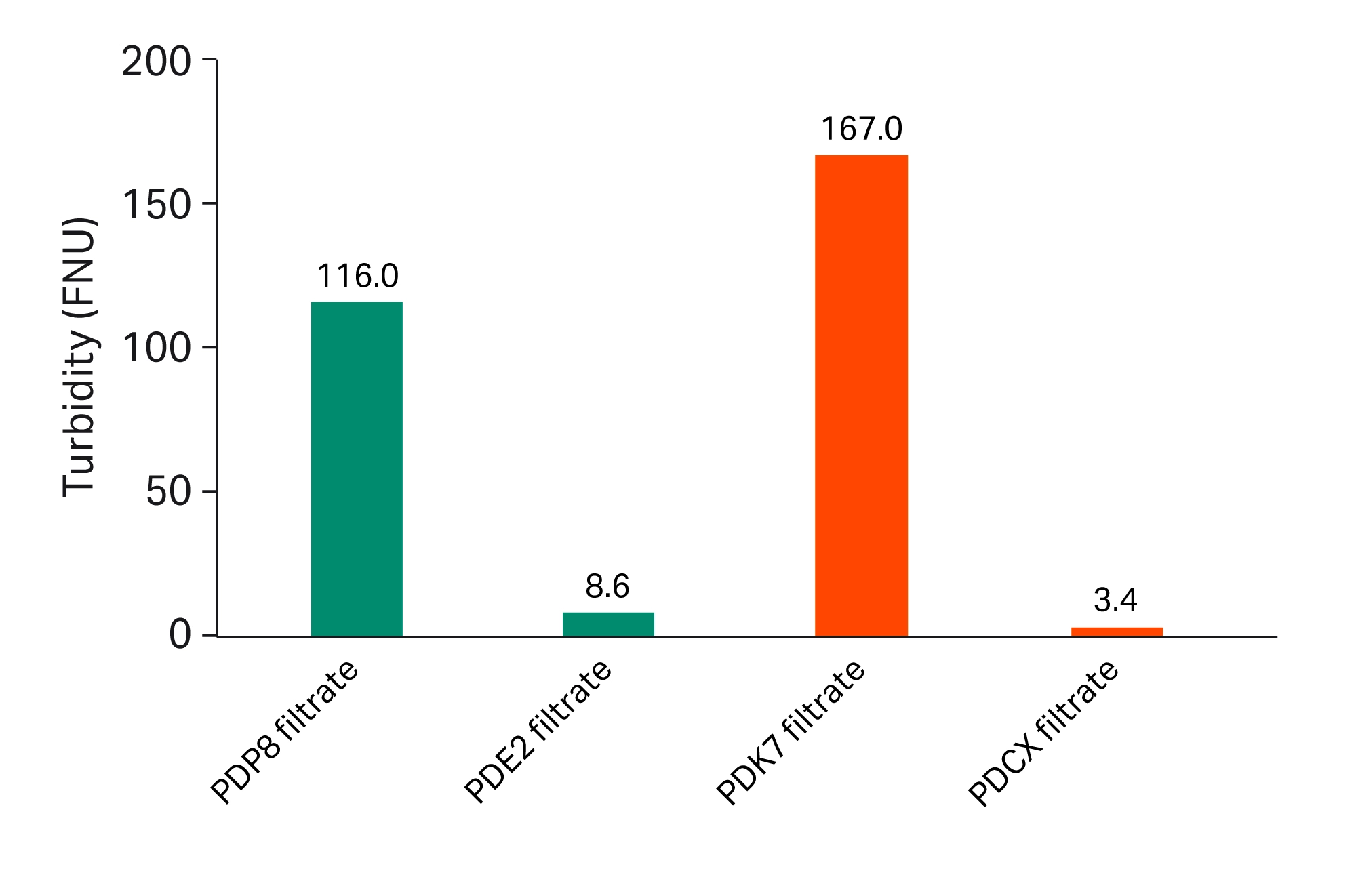
Fig 3. Pre-study depth filtrations on Supracap™ 50 format for Train 1 (green) and Train 2 (orange).
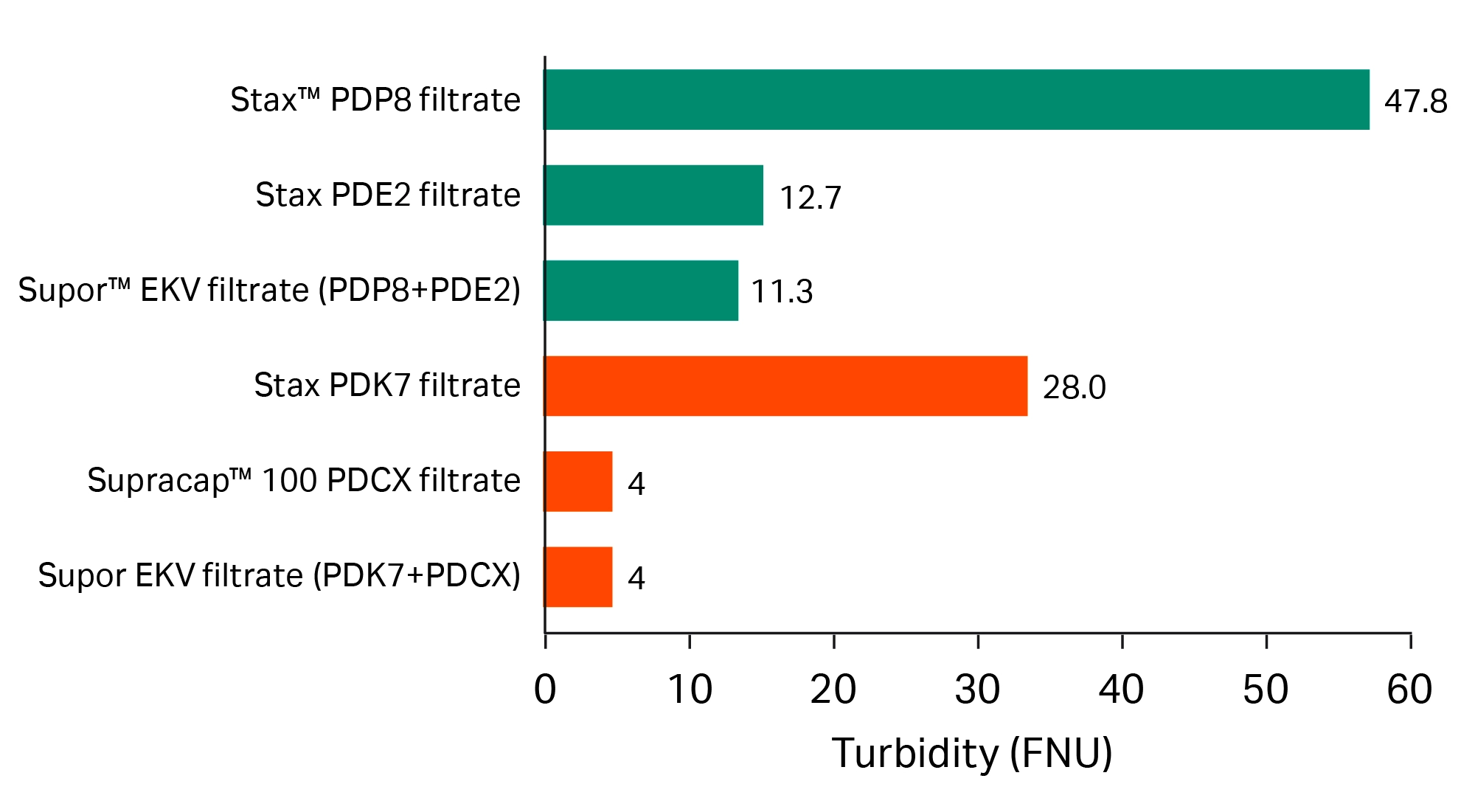
Fig 4. Main bulk depth filtration on Stax™ and Supracap™ 100 format for Train 1 (green) and Train 2 (orange) and Supor™ EKV filtrations.
Note: Lower stage one filtrate turbidities were observed from the Stax™ capsules when compared to the Supracap™ 50 capsules however, this was not surprising as the load on the Stax™ capsules was substantially lower.
Conclusion
Two different depth filter trains were tested as primary and secondary clarification in this study. Both gave good results for midstream clarification of challenging high density fed-batch cell culture.
As expected, the tighter depth filter train of PDK7 plus PDCX generated a filtrate pool with a lower turbidity (3 to 4 NTU) compared to that of the PDP8 plus PDE2 train (9 to 13 NTU). However, the PDP8 plus PDE2 option resulted in higher throughput.