Introduction: viscous feeds and protein A column bed instability
Optimal column packing is key to unlocking the full potential of modern chromatography resins. For protein A resins, a well-packed bed is necessary for high productivity, stable pressure-flow behavior, and consistent purification results batch to batch. But as modern upstream processes deliver increasingly higher mAb titers, previously sufficient methods may need re-optimizing. This was the case for a customer, who encountered pressure and bed instability issues when purifying a highly viscous mAb feed using MabSelect PrismA™ protein A resin.
We revisited the resin packing procedure to explore whether changing the packing solution might help solve this problem. Specifically, we evaluated sodium chloride (NaCl) as an alternative to deionized water (dH₂O) to determine whether adjusting ionic strength could enhance packing efficiency. We found that 0.15 M NaCl reduced bed instability through improved pressure-flow characteristics and increased bed robustness, offering a simple yet effective optimization that supports consistent and reproducible column performance.
Background and approach
MabSelect PrismA™ resin is typically packed using dH₂O. However, even small adjustments to packing conditions can have a large influence on how the resin bed consolidates and behaves under flow. Literature and our development experience have shown that ionic strength and buffer composition can affect particle interactions within a packed bed (1). The presence of NaCl specifically can help minimize electrostatic repulsion between resin particles, promoting stable bed formation and flow consistency.
Here we explored whether using 0.15 M NaCl as an alternative to dH2O for packing a protein A resin would have an impact on column performance. We packed MabSelect PrismA™ resin in AxiChrom™ 300 columns to a 20 cm bed height, using either 0.15 M NaCl or dH₂O as the packing solution but keeping all other conditions equivalent. We then compared packing efficiency and pressure-flow characteristics between the columns.
Materials and methods
Materials and methods
Packing trials were performed using MabSelect PrismA™ resin in an AxiChrom™ 300 column equipped with 10 µm stainless steel bed supports. Packing was conducted using the AxiChrom™ control unit and intelligent packing mode to a 20 cm bed height, with 0.15 M NaCl and dH₂O used as packing solutions for comparison.
| Column: | AxiChrom™ 300/300 |
| System: | ÄKTA process™ CFG 10 mm PP |
| Resin: | MabSelect PrismA™ resin |
| Packing solution: | dH2O or 0.15 M NaCl |
| Performance test: | 0.01 column volumes (CV) of 2% acetone in water at 30 cm/h |
Beds were evaluated for efficiency, pressure-flow performance, and stability. Column qualification included measurements of plate numbers, reduced plate height (h), and asymmetry (As). The acceptance criteria for column efficiency were h ≤ 3 (> 5600 N/m at d50v = 60 μm) and 0.8 < As < 1.5, in accordance with packing guidelines for AxiChrom™ columns and MabSelect PrismA™ resin.
Pressure-flow tests were performed with water up to each packed bed’s gap formation flow rate (the rate at which there is a gap between the adapter and the bed). All data was normalized to 20 cm bed height and 20°C. In the data presented in Figure 2, the hardware contribution was subtracted to reflect the pure resin bed flow performance.
For more details on standard packing recommendations, see Chromatography column packing - MabSelect PrismA™ resin.
Results and key observations
Effect of NaCl on bed stability
We evaluated the impact of using 0.15 M NaCl instead of dH2O as a packing solution for MabSelect PrismA™ resin by comparing column performance data for each. Specifically, we evaluated flow characteristics, pressure characteristics, and overall bed performance and robustness.
When we compared pressure-flow curves and column efficiency data, the influence of ionic strength on bed consolidation and flow performance was clear.
Table 1. Performance metrics for MabSelect PrismA™ resin at 20 cm bed height packed with dH2O or 0.15 M NaCl as packing buffer.
| Packing | Test | |||||
|---|---|---|---|---|---|---|
| Packing buffer | Packing No | Bed height (cm) | Packing factor (PF) | Plates per meter (N/m), downflow | Reduced plate height (h), downflow | Asymmetry (As), downflow |
| dH2O | 1 | 20 | 1.18 | 10 600 | 1.6 | 1.16 |
| dH2O | 2 | 20 | 1.21 | 8500 | 2.0 | 0.99 |
| dH2O | 3 | 20 | 1.24 | 4600 | 3.6 | 0.82 |
| 0.15 M NaCl | 1 | 20 | 1.18 | 10 800 | 1.5 | 1.17 |
| 0.15 M NaCl | 2 | 20 | 1.21 | 10 200 | 1.6 | 1.21 |
| 0.15 M NaCl | 3 | 20 | 1.24 | 10 200 | 1.6 | 1.14 |
| 0.15 M NaCl | 4 | 20 | 1.27 | 5800 | 2.9 | 0.95 |
| 0.15 M NaCl | 5 | 20 | 1.30 | 2200 | 7.5 | 2.13 |
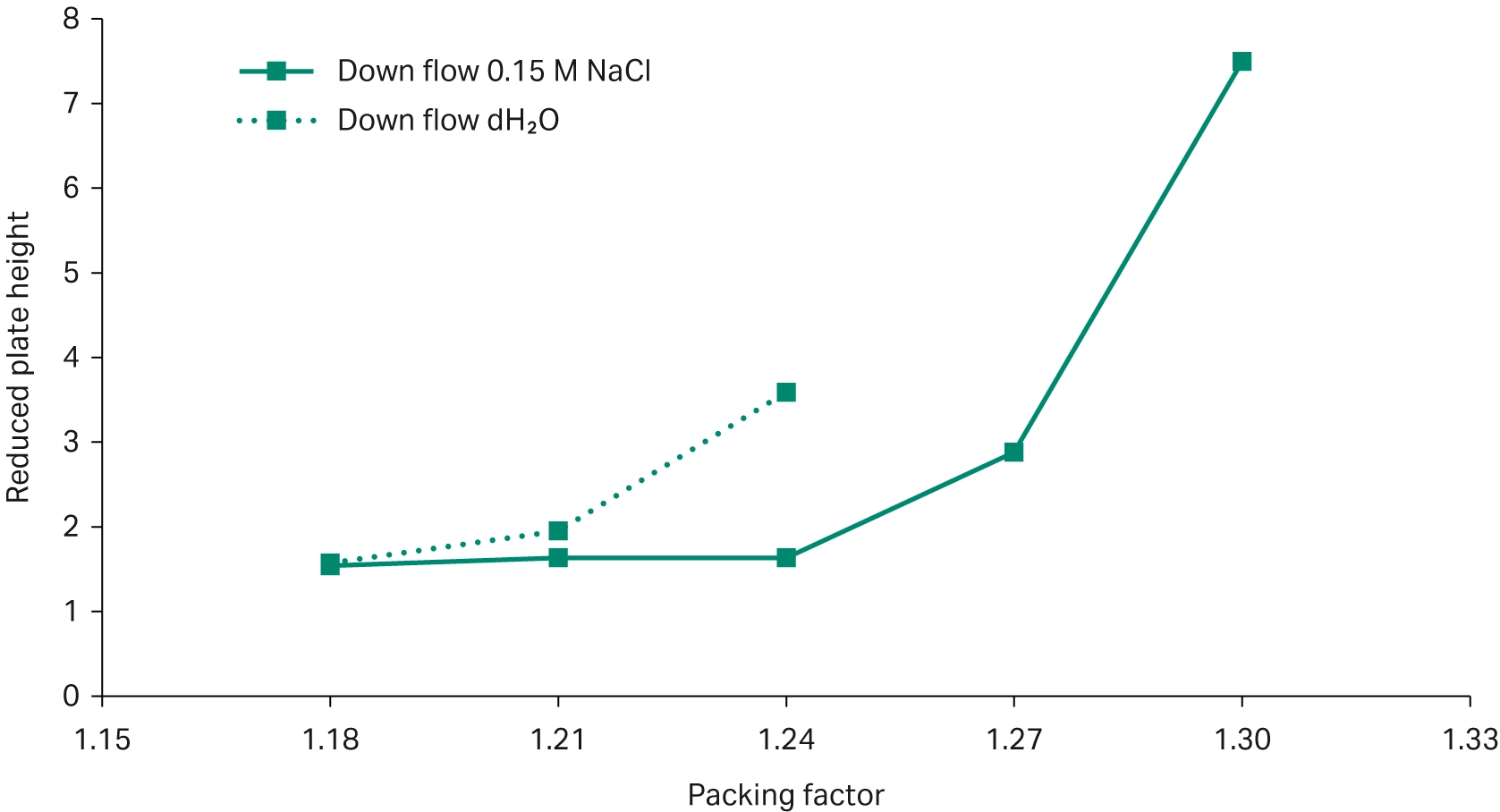
Fig 1. Effect of packing solution on column performance. We measured reduced plate height (h) for different packing factors in columns packed with MabSelect PrismA™ resin using either 0.15 M NaCl or dH2O.
As Figure 1 shows, columns packed with 0.15 M NaCl showed more efficient bed performance, as indicated by the lower h values across packing factors compared to those packed using dH₂O.
To further assess flow characteristics, we conducted pressure-flow testing on each packed bed (Fig 2 and Table 1). Columns packed using NaCl showed consistently lower bed pressure than those packed with dH₂O at same flow rates, confirming improved flow efficiency.
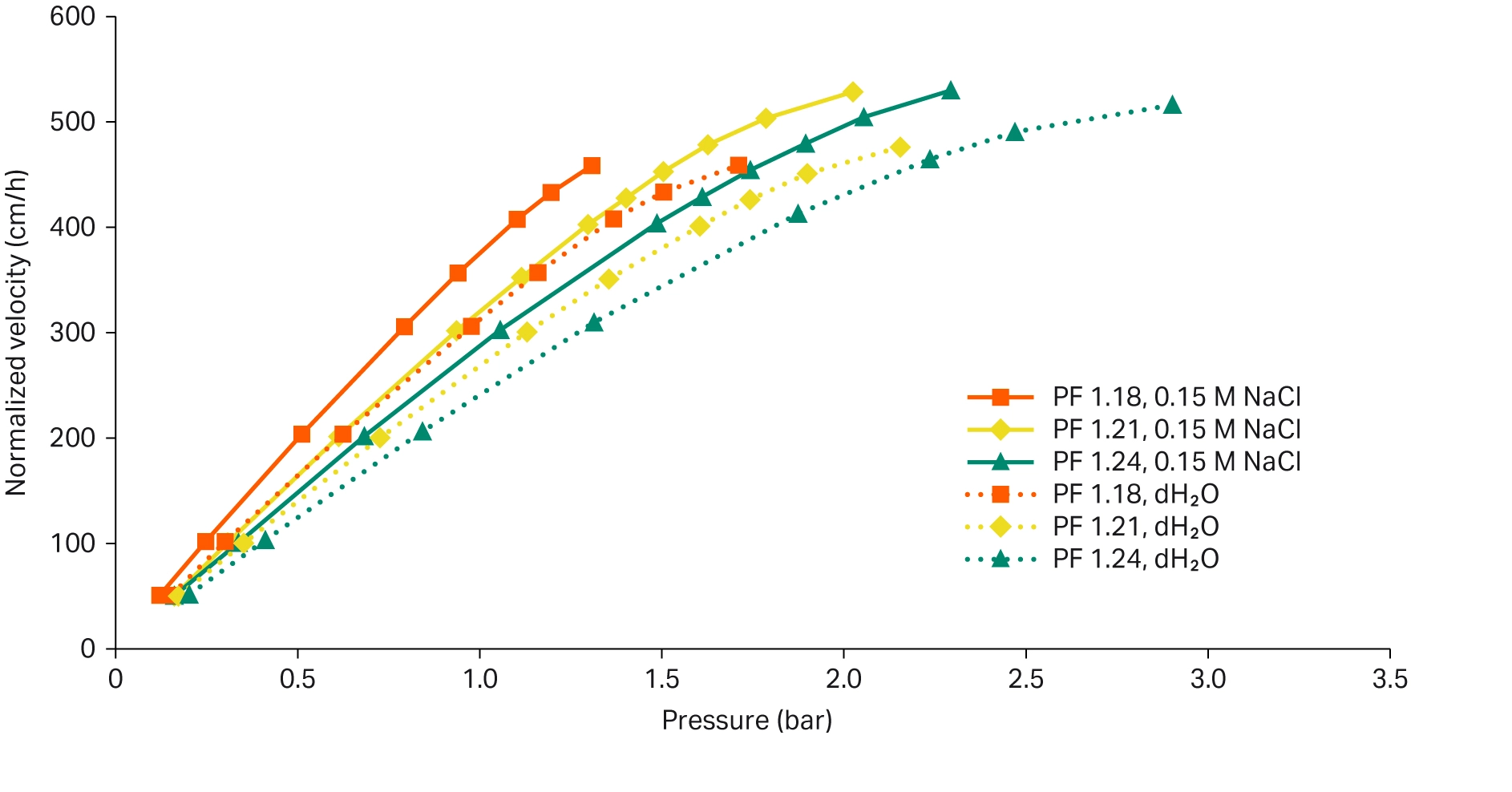
Fig 2. Effect of packing solution on pressure-flow characteristics at different PFs. Shown is normalized velocity as a function of pressure. We used AxiChrom™ 300 columns packed to a bed height of 20 cm with MabSelect PrismA™ resin using NaCl (0.15 M) or dH2O. The highest pressure value in each data set represents the gap formation flow rate. Tubing and hardware pressure are excluded.
Figure 2 shows that at equivalent flow rates, columns packed with NaCl consistently showed lower bed pressure than those packed with dH₂O, demonstrating improved flow properties and reduced flow resistance across all packing factors tested.
At the recommended operating velocity of 300 cm/h, columns packed with NaCl showed an average 17–19% reduction in bed pressure, with smooth and consistent flow profiles across all packing factors (Table 2). This corresponds to an average increase in flow tolerance of 18 - 20 %, enabling operation at higher flow velocities while maintaining the same pressure threshold as water‑packed columns. The reduction in bed pressure also supports use of higher‑viscosity fluids.
Table 2. Percentage difference in bed pressure at operating velocity 300 cm/h (viscosity 1 cP) between columns packed with dH₂O and 0.15 M NaCl.
| Packing factor | PH2O (bar) | PNaCl (bar) | Difference in pressure (NaCl vs dH2O) |
|---|---|---|---|
| 1.18 | 0.98 | 0.79 | –19 % |
| 1.21 | 1.13 | 0.94 | –17 % |
| 1.24 | 1.31 | 1.06 | –19 % |
To confirm packing robustness, we conducted stability tests on columns packed using NaCl at packing factors 1.18 and 1.21, operating continuously for 16 h at 360 cm/h and 420 cm/h, respectively. Column efficiency tests performed afterward showed only 5–8 % variation in plate height and asymmetry, demonstrating excellent bed stability (data not shown).
Conclusion
In conclusion, we found that bed stability in columns packed with MabSelect PrismA™ resin can be improved by using 0.15 M NaCl instead of dH2O as the packing solution. We observed improvement in both column performance and pressure-flow properties of the packed beds. Across all tested packing factors, beds packed with NaCl showed lower pressure than did those packed with dH₂O at the same flow rates. This indicates that NaCl not only improves packing efficiency but also reduces pressure, contributing to better overall column performance supporting processing of higher‑viscosity fluids seen with high‑titer mAbs.
References
- Carta G, Jungbauer A. Protein Chromatography: Process Development and Scale-Up. 2nd ed. Wiley; 2020.