

Per and polyfluoroalkyl substances (PFAS), often referred to as ‘forever chemicals’, are a growing area of concern for biopharmaceutical manufacturers. As PFAS-specific regulations and potential restrictions for the industry develop, end-users need transparency around the presence of PFAS compounds in their process technology, and the environmental risks they may pose. As expectations for product quality and risk mitigation continue to rise, understanding PFAS behavior within critical process materials has become an important part of technology selection and supplier due diligence.
Sterilizing grade gas filters play an important role in the contamination control strategy of most processes. They are used across upstream, downstream, intermediate bioprocessing and final filling operations. These filters typically rely on intrinsically hydrophobic membranes or membranes with hydrophobic surface treatments to ensure reliable gas flow to these critical processes. PTFE and PVDF membranes or coatings, based on fluorinated chemistries, represent the primary potential source of PFAS in gas filtration applications. The detection and quantification of PFAS extractables provides meaningful insight into whether PFAS-containing compounds are present, and their potential to leach into the process or environment.
Materials and methods
Four sterilizing-grade gas filter membranes were sourced from a range of filter suppliers to the market (Table 1) to evaluate the presence of PFAS compounds. Triplicate membrane samples from each filter part number were extracted and analyzed.
Table 1. Gas filter sample information
|
Filter range |
Part number |
Membrane construction |
|
Cytiva Emflon™ PFR |
AB1PFR7PVH4 |
PTFE |
|
Cytiva Emflon II |
KA3V002PV1G |
PVDF |
|
Merck Durapore |
CVGB71TP3 |
PVDF |
|
Sartorius Sartopore Air |
5195307A7G-SS |
Hydrophobic PES |
A 5 g membrane sample was collected from each filter cartridge or capsule for analysis. The extraction and analysis of all samples was conducted by an independent laboratory with established methods for evaluating a wide range PFAS substances. Membrane samples were soaked in methanol for 2 hours at 60°C in an ultrasonic bath to promote the release of potential PFAS extractables. A total of 58 PFAS compounds, including PFOA, PFOS, PFCA species, PFHxS, FTOHs, and acrylates, were screened and quantified by LCMS/MS (ESI-) following the DIN EN 17681-1:2025 test method. Reporting limits for individual PFAS ranged between 10 and 400 µg/kg.
Results
The test results for compounds identified above the reporting limit in each of the filter samples analyzed are shown in Table 2 and Figure 1.
Table 2. Detected PFAS extractables
|
PFAS identified |
||||
|
Common name |
6:2 Fluorotelomer alcohol |
Perfluorohexanoic |
Perfluorbutanoic |
6:2-fluoroteomersulfonic |
|
CAS number |
647-42-7 |
307-24-4 |
375-22-4 |
27619-97-2 |
|
Common usage |
Surfactants and hydrophobic coatings | Water resistant coatings and a breakdown product of 6:2 FTOH | A breakdown product of 6:2 FTOH | Processing aid used in the production of some fluoropolymers |
|
Membrane sample |
Measured extractablesa (µg/kg) |
|||
|
Cytiva Emflon PFR |
<RL b |
<RL b |
<RL b |
<RL b |
|
Cytiva Emflon II |
<RL b |
<RL b |
<RL b |
<RL b |
|
Merck Durapore |
<RL b |
<RL b |
<RL b |
24 c |
|
Sartorius Sartopore Air |
7.6 ×10⁶ |
45 |
17 |
<RL b |
|
a Mean values n=3, excluding datasets with a removed outlier (see c). b RL; The reporting limit (RL) accounts for variation across multiple daily, calibrated limits of quantitation (LOQ) to enable consistent comparison between results. Reporting limits are 100 µg/kg for 6:2 FTOH, and 10 µg/kg for PFHxA, PFBA, and 6:2 FTS. c An outliner value (800 µg/kg) was removed from the calculation. |
||||
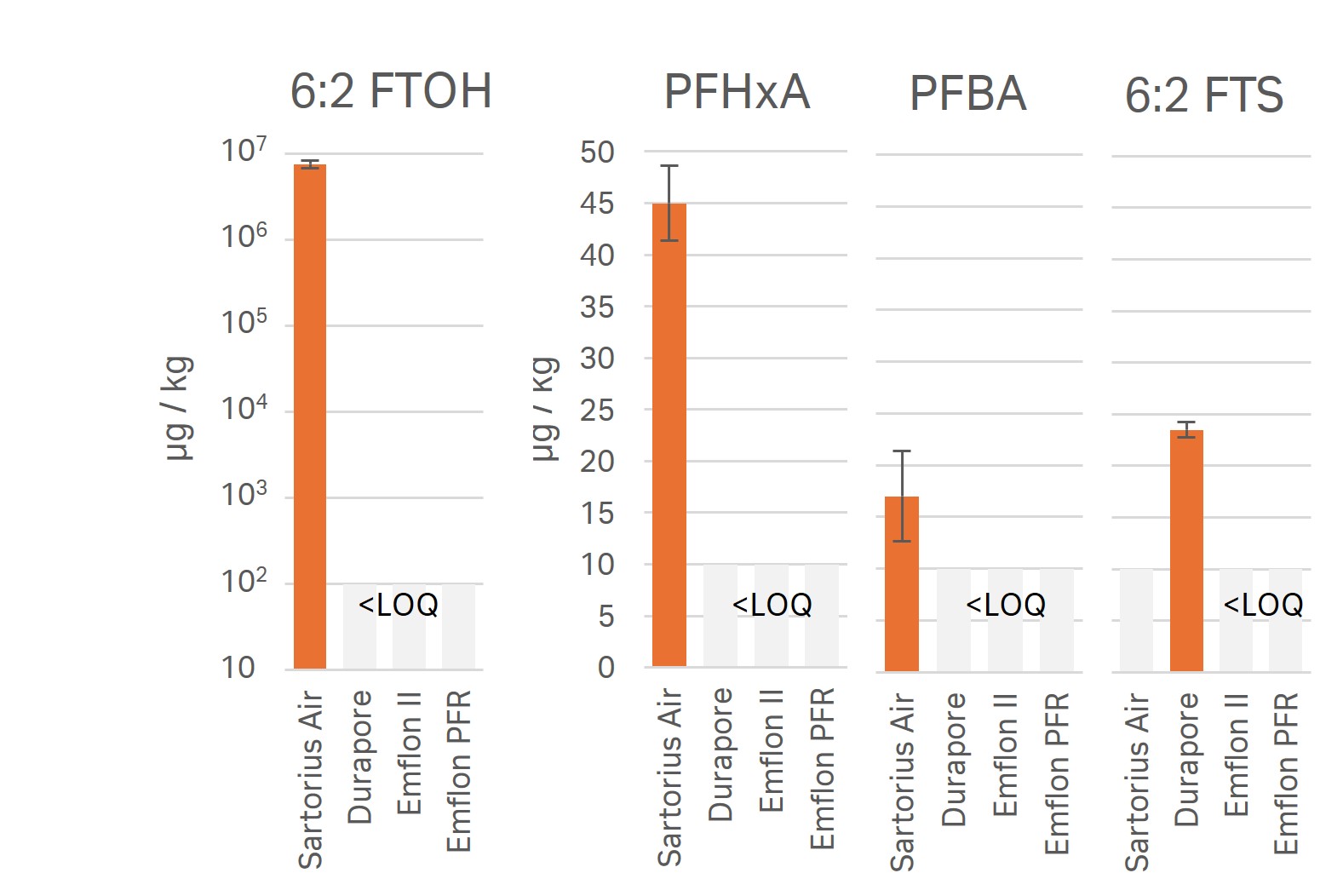
Fig 1. Summary of detected PFAS extractables. Error bars represent ± standard deviation; n=3a,c, p=<0.05
Discussion
The Cytiva Emflon PFR and Emflon II gas filter membranes, showed no detectable PFAS extractables under the test conditions. This outcome demonstrates that, despite being constructed from PFAS-containing materials (PTFE and PVDF respectively), these products do not release measurable PFAS compounds into the extraction solvent under the tested conditions. These data support the conclusion that there is a low risk of PFAS leaching into a process or into the environment for these filters.
Conversely, the Sartopore Air membrane tested, that uses a hydrophobic PES membrane, exhibited high levels of 6:2 FTOH, along with trace amounts of PFHxA and PFBA. This pattern indicates that the hydrophobic treatment applied to the PES membrane is PFAS-containing, and leach readily under the extraction conditions described. These data would support an increased risk of PFAS leaching into a process or the environment compared to other filter membranes in this test.
The Durapore membrane (PVDF) showed measurable levels of 6:2 FTS in all replicate extractable profiles. This finding suggests that some PVDF membrane materials may use, or be exposed to, fluorosurfactants during processing. Critically, when compared to the extractable profile of Emflon II membranes (PVDF), these data indicate that filters with an apparently similar construction do not automatically present equal risk.
Conclusion
A lack of clarity around PFAS can often be confusing. These data explore real-world sterile air filter scenarios with conclusions that differ significantly from what may be expected based purely from a simple material review. In the absence of these data, assessors can only focus on recognizable fluoropolymer names, instead of applying well-understood risk assessment approaches to the levels of specific PFAS compounds that could leach either into the process or the environment.
Cytiva has taken proactive steps to support clear, data-driven PFAS risk assessments for our bioprocessing gas filtration products. This provides end users with the transparency needed to make informed decisions about process and environmental risk, and overall product quality assurance.
As industry navigates increasing scrutiny around PFAS, it is essential that reduction efforts focus on areas where they have meaningful impact. Sound scientific evidence should guide these decisions to avoid misdirection and ensure that changes and resources are applied where they truly matter.