Streamlining HPLC sample prep: Reducing plastic waste by up to 79% with Whatman™ Mini-UniPrep™ syringeless filters
In this application note, we explore the reduction of plastic waste in high-performance liquid chromatography (HPLC) sample preparation using syringeless filters. HPLC is a critical analytical technique across various fields, and effective sample preparation is essential for accurate results. Traditional sample preparation involves multiple consumables, leading to increased waste, time, and cost. The Whatman™ Mini-UniPrep™ syringeless filter streamlines this process, reducing preparation time and plastic waste.
We demonstrate in this comparative study1 that using Mini-UniPrep™ syringeless filters can:
- Reduce plastic waste by up to 79% compared to a conventional sample preparation method incorporating a 33 mm syringe filter and a 10 mL syringe.
- Act as a sustainable alternative for HPLC sample preparation, decreasing plastic waste.
1 The study did not take the weight of any plastic packaging into account.
Introduction
HPLC is an analytical technique used to separate, identify, and quantitate compounds in a liquid sample. The technique is widely used, and has a critical role in various fields ranging from pharmaceutical, to food and beverage, environmental safety, forensics, and toxicology.
Reproducibility and specificity are important within these fields, and sample preparation represents a key step. Effective sample preparation practices improve the resolution of your chromatogram peaks, the differentiation of compounds in samples, reduce background noise of the baseline that could cover true signals of analytes and increase the sensitivity of your analyses. Sample preparation can also extend the life of consumable parts of HPLC systems, decrease system wear and tear, and preserve the integrity of your system.
Filtration plays an essential role in the preparation of your HPLC samples. Consumable selection may vary between laboratories based on factors such as sample volume, filtration area, and required pore size. Nevertheless, conventional sample preparation involves multiple consumables, such as syringes, syringe filters, vials, and caps with septa, which increase the time required for sample preparation, cost, and waste (Fig 1).
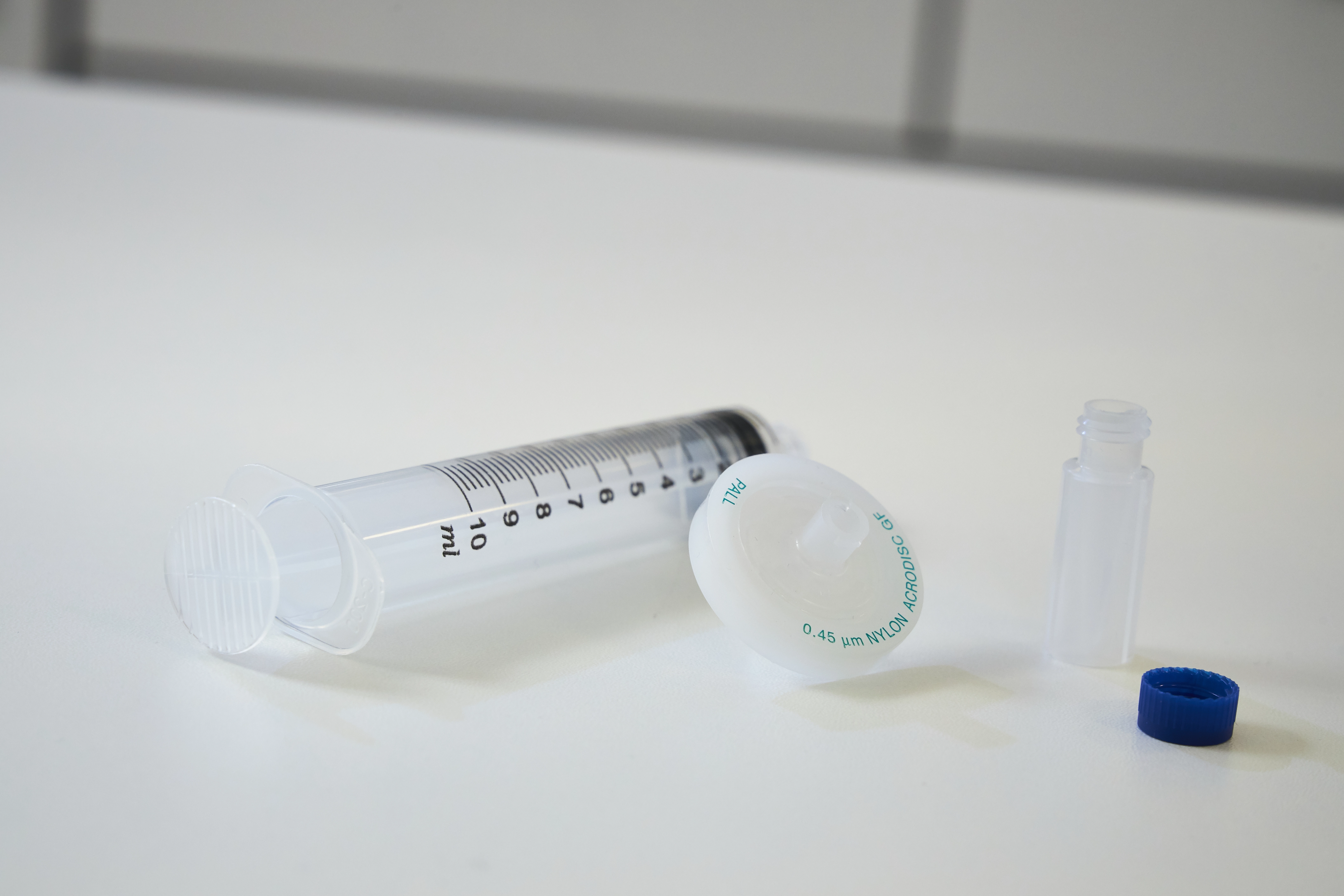
Fig 1. Image of consumables used in conventional HPLC sample preparation. The conventional sample preparation workflow includes the use of syringes, syringe filters, vials, and caps with septa.
Our Mini-UniPrep™ syringeless filters eliminate the requirement for separate disposable consumables, and enable the preparation of samples in one-third of the time required for traditional HPLC sample preparation methods (Fig 2).
Here, we compare the average amount of plastic waste generated in the Whatman™ Mini-Uniprep™ syringeless filter workflow vs the conventional HPLC sample preparation workflow incorporating 13, 15, 25, and 33 mm syringe filters.

Fig 2. The Whatman™ Mini-Uniprep™ syringeless filter. These syringeless filters are a 4-in-1 device that integrates an autosampler vial, filtration membrane, plunger, and a cap with a septum into a single consumable product.
Materials and methods
We performed the comparative study described here at the Cytiva Walton Road site (Portsmouth, UK) in 2024. The materials we used in the study are summarized in Table 1.
Table 1. List of materials used
| Filter | Manufacturer |
| Whatman™ Mini-UniPrep™ syringeless filter, translucent housing, slit septum cap, 0.45 μm, 12 × 32 mm, PTFE membrane | Cytiva |
| Acrodisc™ syringe filters, PTFE membrane, 0.45 μm, 13 mm, nonsterile | Cytiva |
| Acrodisc™ syringe filters, PTFE membrane, 0.45 µm, 25 mm, nonsterile | Cytiva |
| Whatman™ Puradisc™ syringe filters, PTFE membrane, 0.45 μm, 13 mm, nonsterile | Cytiva |
| Whatman™ Puradisc™ syringe filters, PTFE membrane, 0.45 μm, 25 mm, nonsterile | Cytiva |
| Minisart SRP syringe filter hydrophobic PTFE membrane, 0.45 μm, 15 mm, nonsterile | Sartorius |
| Minisart SRP syringe filter hydrophobic PTFE membrane, 0.45 μm, 25 mm, nonsterile | Sartorius |
| Millex-FH syringe filters, hydrophobic PTFE membrane, 0.45 μm, 13 mm, nonsterile | Merck Millipore |
| Millex-FH syringe filters, hydrophobic PTFE membrane, 0.45 μm, 33 mm, nonsterile | Merck Millipore |
The aim of this study was to compare the average amount of plastic waste generated during the preparation of 10 HPLC samples using two different workflows, the conventional sample preparation method and the Mini-UniPrep™ syringeless filter workflow. To model the plastic waste generated in conventional HPLC sample preparation, we used two syringe sizes (5 and 10 mL), and a range of syringe filter diameters (13, 15, 25, and 33 mm) sourced from Cytiva, Sartorius, and Merck Millipore, and all commonly used in laboratory workflows (Table 1).
All syringe filters used in the study were equipped with hydrophobic PTFE membranes. We recorded the weight of 10 syringes, syringe filters, polypropylene HPLC vials, and caps with septa.
For the Mini-UniPrep™ syringeless filter workflow, we weighed and recorded 10 filters along with the pipette tips (Eppendorf) used during sample preparation. The weight of the plastic packaging that the consumables were supplied in was not recorded as this was outside the scope of the study.
Results and discussion
The mean weight of plastic waste generated in the preparation of HPLC samples by the conventional method incorporating a 5 mL syringe ranged from 7.22 ± 0.03 g to 10.23 ± 0.02 g (Fig 3). We found a correlation between the size of the syringe filter used in the workflow and the mean weight of plastic waste generated.
The use of our 13 mm Acrodisc™ and Puradisc™ filters, the 13 mm Millex-FH, and the 15 mm Minisart SRP syringe filters resulted in 7.22 ± 0.03, 7.49 ± 0.02, 7.95 ± 0.03, and 8.18 ± 0.03 g of plastic waste being generated, respectively (Fig 3). In comparison, the use of 25 mm Acrodisc™ and Puradisc™ syringe filters resulted in 8.96 ± 0.05 g and 9.01 ± 0.02 g of plastic waste, while the 25 mm Minisart SRP and 33 mm Millex-FH filters generated 10.00 ± 0.03 g and 10.23 ± 0.02 g of waste (Fig 3).
We found that the mean weight of plastic waste generated using the Mini-UniPrep™ syringeless filter workflow was 2.66 ± 0.01 g (Fig 3). Use of the Mini-UniPrep™ syringeless filter workflow resulted in a 63%, 65%, 67%, and 68% reduction in plastic waste when compared to conventional workflows incorporating 13 mm Acrodisc™ and Puradisc™, 13 mm Millex-FH, and 15 mm Minisart SRP syringe filters, respectively.
Using the Mini-UniPrep™ syringeless filter reduced the plastic waste by 70% compared to 25 mm Acrodisc™ and Puradisc™ syringe filters, and by 73% compared to the 25 mm Sartorius (Minisart SRP) syringe filters. We also observed a 74% reduction in plastic waste using the syringeless filter workflow compared to the conventional workflow incorporating the 33 mm Merck Millipore (Millex-FH) syringe filter.

Fig 3. Mean plastic waste generated in the Mini-UniPrep™ syringeless filter vs conventional HPLC sample preparation workflows using a 5 mL syringe. Significant differences in plastic waste were observed by a two-sample t-test assuming unequal variance between the Mini-UniPrep™ syringeless filter workflow and the conventional HPLC sample preparation workflow incorporating syringe filters from Cytiva, Sartorius, and Merck Millipore (p < 0.05)
Increasing the size of the syringe from 5 to 10 mL increased the plastic waste produced for the conventional HPLC sample preparation workflow. The mean plastic waste generated in the preparation of HPLC samples ranged from 9.77 ± 0.04 g to 12.78 ± 0.04 g (Fig 4).
The use of 13 mm Acrodisc™ and Puradisc™ filters, 13 mm Millex-FH, and 15 mm Minisart SRP syringe filters resulted in 9.77 ± 0.04, 10.04 ± 0.04, 10.50 ± 0.04, and 10.73 ± 0.04 g of plastic waste being generated, respectively (Fig 4). Compared to conventional workflows using 13 mm Acrodisc™ and Puradisc™ syringe filters, the Mini-UniPrep™ syringeless filter reduced plastic waste by 73% and 74%, respectively. In addition, we observed a 75% reduction compared to workflows using the 13 mm Millex-FH and the 15 mm Minisart SRP syringe filters.
Consistent with previous results, we found that the mean plastic waste produced increased when the larger variants of the syringe filters were incorporated into the conventional workflow. For example, incorporating a 25 mm Acrodisc™ and Puradisc™ syringe filters resulted in 11.50 ± 0.04 g and 11.56 ± 0.04 g of plastic waste, respectively (Fig 4). Switching over to the Mini-UniPrep™ syringeless filter workflow in this instance resulted in a 77% reduction in plastic waste. Finally, we observed the highest levels of plastic waste when using the conventional workflow with 25 mm Minisart SRP (12.55 ± 0.04 g) and 33 mm Millex-FH (12.78 ± 0.04 g) syringe filters (Fig 4). Switching to the Mini-UniPrep™ syringeless filter workflow reduced plastic waste by 79%.

Fig 4. Mean plastic waste generated in the Mini-UniPrep™ syringeless filter vs conventional HPLC sample preparation workflows using a 10 mL syringe. Significant differences in plastic waste were observed by a two-sample t-test assuming unequal variance between the Mini-Uniprep syringeless filter workflow and the conventional HPLC sample preparation workflow incorporating syringe filters from Cytiva, Sartorius, and Merck Millipore (p < 0.05)
In this study, we demonstrated that using our Mini-UniPrep™ syringeless filter reduces plastic waste compared to the conventional HPLC sample preparation method. The results suggest that the Mini-UniPrep™ syringeless filter can be used as a sustainable alternative for HPLC sample preparation. However, in some applications, the use of syringeless filters may not be suitable. This is particularly relevant where the sample contains high levels of particulates that can clog the filter. Where this is the case, you would need to use conventional HPLC sample preparation.
There are still effective strategies that you can use to reduce plastic waste produced by the more traditional approach. We will use data from the study to demonstrate this. Firstly, you can reduce the size of the syringe filter used in your sample preparation. Switching from a 25 mm Acrodisc™ syringe filter to a 13 mm version can reduce mean plastic waste from 11.5 ± 0.04 g to 9.77 ± 0.04 g, which is equivalent to a 15% reduction.
In addition, you can also use smaller syringes. Reducing the size of the syringe from 10 to 5 mL, while using our 25 mm Acrodisc™ syringe filter, reduces the mean plastic waste from 11.5 ± 0.04 g to 8.96 ± 0.05 g, which represents a 22% reduction. The most impactful strategy for those conscious of sustainability would be to reduce the size of the syringe and of the syringe filter, which can lower the mean plastic waste from 11.5 ± 0.04 g to 7.22 ± 0.03 g and represent a mean reduction of 4.28 g. This is equivalent to a 37% reduction in plastic waste2.
2 In some cases, a larger effective filtration area may be required to ensure efficient filtration. In such instances, downsizing the syringe filter may not be feasible.
Conclusion
- The result of this comparative study demonstrates that the use of the Whatman™ Mini-UniPrep™ syringeless filter in HPLC sample preparation reduces the amount of plastic waste generated when compared to conventional preparation methods.
- The reduction in plastic waste (excluding plastic packaging) indicates that the Mini-UniPrep™ is a more sustainable alternative for HPLC sample preparation.
- For conventional HPLC sample preparation workflows, reducing the size of both the syringe and the filter presents a straightforward and effective approach to minimizing plastic waste.
CY55873