This article guides your selection of the right Supracap™ depth-filter capsules for laboratory use and for scale-up process development. We detail the types of filter media, their applications, and how to optimize filtration processes for various biological solutions.
Introduction
Supracap depth filter capsules come in various sizes and are designed for depth filtration and sample preparation in downstream bioprocessing of 1 to 100 L of solution. These solutions, typically coming from cell cultures, fermentation broths, and cell lysates, which often contain large particulate loads of variable sizes that can be difficult to filter using standard membrane filters.
Membrane filters are thin, typically with a narrow pore size distribution that prevent particles larger than the rated pore size from passing through the membrane filter. During filtration, particulate matter larger than the pore size builds up on the membrane surface, eventually clogging all the pores until no more solution can be filtered. This is especially true for samples that contain high amounts of debris or particulate matter. This debris can quickly cover the surface of the membrane, thereby dramatically decreasing filtering capacity. For these solutions, depth filtration is more efficient because a third dimension, thickness, is added to the filter to trap particulate matter both at the surface and throughout the inside of the entire filter media. In addition, different media substrates can be layered to more effectively capture debris and particulate matter. This gives depth filtration capsules a much higher hold capacity for debris capture than is possible with a membrane, allowing for more solution to be filtered.
The depth-filter modules contain the same media materials as our larger volume, production-sized units capable of filtering hundreds of liters of solution at a time. This gives users assurance that scalability will never be a problem.
With two different types of filter media in three different configurations (Table 1), the modules cover a wide range of particle size removal, allowing the user to selectively target a variety of size ranges for efficient clarification of media. The Supracap 50 filter capsule has the smallest volume, typically used for 1 to 3 L of solution. The larger Supracap 100 filter capsules come in different sizes that can be used to filter up to 100 L.
By choosing the correct Supracap filter capsule, throughput can be maximized, saving time and money.
The correct choice of filter type allows for removal of cells of differing sizes (e.g., bacteria, yeast, and mammalian cells), clarification of cell debris, cell lysates, or purification of blood/serum. The capsules can also be stacked, greatly increasing throughput by allowing filters with different removal ratings to work in tandem to maximize the removal of debris and particulate matter from a solution.
Filter media
The filter capsules contain one or two different types of media for filtration in a total of three different configurations. The first type of depth filtration media is Seitz BIO 20, which consists of highly purified natural and modified cellulose fibers that are free from inorganic materials. It has the tightest removal rating of our Supracap filters at 0.4 to 1 μm.
The second media type found in the filter capsules is the Seitz P-Series (P100-P900), which is a more layered and complex media that is comprised of cellulose fibers, filter aids such as diatomaceous earth and perlite, and other resins that offer broader removal ranges than the BIO 20 media.
The last media type is Seitz HP-Series (PDD1–PDP8). This media contains two layers of Seitz P-Series depth filter sheets arranged so a more permeable layer is followed by a less permeable layer to increase flow rate and flowthrough of high particulate solutions. Figure 1 shows the three different media configurations along with their respective removal ratings.
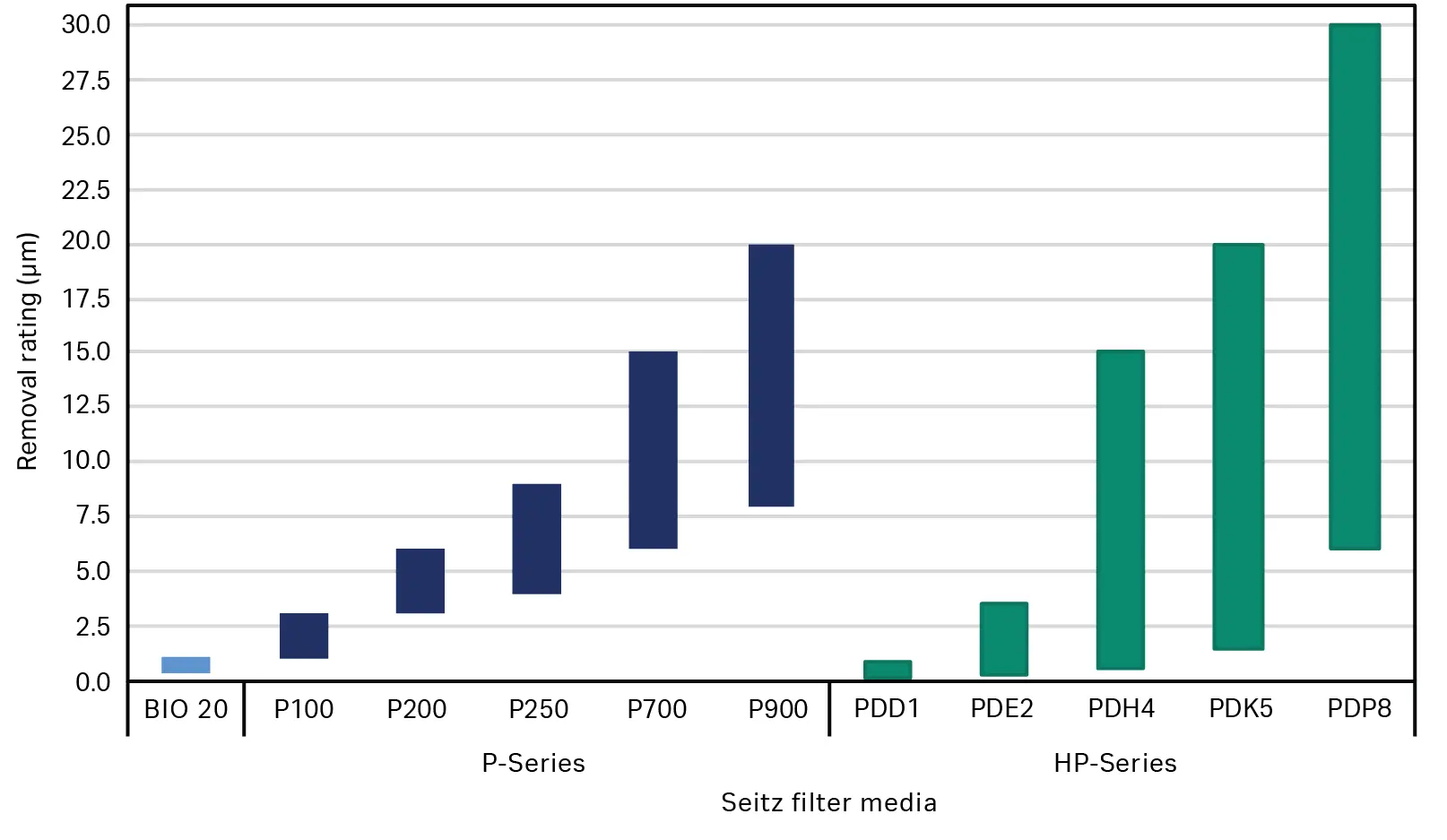
Fig 1. Depth filtration ranges for Supracap depth filter capsule media.
Choosing the right filter media
We manufacture Seitz BIO 20 media to have reduced levels of ash and heavy metal extractables. These filters are typically used when downstream applications are sensitive to metal ions. The 0.4 μm final cutoff makes it useful for final filtration steps and can be paired with other Supracap filters or used as a clarifying filtration step of supernatants after centrifugation.
With a maximum removal rating of 1 μm, solutions with larger particulate sizes, like cell cultures or fermenter broths containing cellular debris, will need pre-clarification before being filtered through the BIO 20 Supracap filters to maximize flowthrough.
The BIO 20 media can also protect chromatography columns or prevent rapid fouling of downstream sterile filtration membranes. The filtrate is suitable for further processing via tangential flow filtration (TFF) or can be used for the filtration of biopharmaceutical or therapeutic proteins.
Our Seitz P-series filters are manufactured to have low endotoxin levels and minimal release of extractables. These filters contain positively charged resins resulting in an electrokinetic adsorption potential that increases the retention of whole and crushed cells, cell lysate debris, endotoxins and other negatively charged host cell proteins, nucleic acids, and negatively charged viruses to better clarify biological solutions.
The P100, P200, and P250 depth filters are for filtration of particulate matter in the 1 to 9 μm range and are typically used for filtration of cell-free fermenter broth, preparation of material for TFF, therapeutic proteins or vaccine purification, and blood/ serum separation. Seitz P700 and P900 have a broader and higher range for coarser filtration, with a range from 6 to 20 μm and are useful for general cell removal from cell culture media (bacteria, yeast, or mammalian/insect cells).
Seitz HP-series filters are composed of two layers of Seitz P-series filter media. They share the same properties as the P-series material while having a high dirt/particle holding capacity. They are designed specifically to provide maximum throughput for particulate laden biological, bioprocess, and/or pharmaceutical samples.
PDD1 depth filters have the tightest removal rating of the four HP-series filters with the smallest final pore size. While having a removal rating similar to BIO 20, the double layer nature of PDD1 makes it a better choice for general use as it captures a broader range of particles and due to its dual layer nature also has a higher capacity for debris capture.
Like the BIO 20, PDD1 offers excellent instrument and membrane protection. PDE2 depth filters are similar to the P100 and P200 media, but again with a broader removal rating. PDE2 also offers excellent membrane protection for downstream processes. PDD1 and PDE2 are most effective when used for secondary clarification after centrifugation or following initial filtration through higher rating depth filters.
The final three filter medias, PDH4, PDK5, and PDP8, have high debris holding capacities and work well for cell and debris removal from fermentation feeds or cell culture media, with PDP8 being able to effectively clear cells at a 35 million cells/mL concentration while PDH4 and PDK5 should be used when the cell concentration is at or below 10 million cells/mL. They are both excellent choices in post-fermentation applications, with the PDH4 media have a small enough final pore size to offer some membrane protection for other downstream applications like TFF.
Stacking depth-filter capsules to increase capacity
Maximizing total output occasionally requires stacking different filter capsules in series. For example, we have designed a system for clarifying cell culture media that is well suited for monoclonal antibody (mAb) production that places a PDP8 Supracap filter in series with a PDE2 filter. The Seitz PDP8 HP-series filter media has a 6 to 30 μm size range (Fig 1). This provides a more efficient removal of whole cells while allowing smaller debris to pass through the filter media.
What flows through the PDP8 Supracap filter is then filtered by a PDE2 filter. This filter combination does its job by first clarifying mAb production media with high cell counts, up to 35 million cells per mL, then removing finer particulate matter to make the solution ready for downstream processing. The use of a PDP8 filter capsules followed by a PDE2 filter is the same setup as our Stax™ mAx clarification platform that can handle hundreds of liters of media at a time. This highlights the ease of scalability from small-scale runs using either 50 or 100 filter capsules to our large-scale depth filtration platforms.
Table 1. Effective filtration area (EFA) of depth filter capsules
| Supracap capsule | Capsule size | EFA (cm2) | Connection type | Seitz media type |
Removal rating (µm) |
General use |
|
|---|---|---|---|---|---|---|---|
| 50 | n/a |
22 |
Luer |
Bio 20 |
0.4–1.0 |
Final filtration, clarifying supernatant, protect columns, prefiltration to TFF. |
|
| 100 | NP5L |
500 | Sanitary flange or 13 mm hose barb | ||||
| NP6 |
1000 |
||||||
| 50 | n/a |
22 | Luer | P series (100, 200, 250, 700, 900) |
1.0–3.0 |
Cell lysate, removal of endotoxin and negatively charged biomolecules, therapeutic protein or vaccine purification, and blood/ serum separation. |
|
| 100 | NP5L |
500 | Sanitary flange or 13 mm hose barb | 3.0–6.0 |
As above. |
||
| NP6 |
1000 | 4.0–9.0 |
As above. |
||||
| 6.0–15.0 8.0–20.0 |
Retention of whole/crushed cells, general cell, removal from cell culture media (bacteria, yeast, or mammalian/insect cells). |
||||||
| 50 |
n/a |
22 |
Luer |
HP series (PDD1, PDE2, PDH4, PDK5, PDP8) |
0.1–0.85 |
Final filtration, clarifying supernatant, protect columns, prefiltration to TFF. |
|
| 100 |
NP5L |
250 |
Sanitary flange or 13 mm hose barb |
0.2–3.5 0.5–15.0 |
Cell lysate, removal of endotoxin and negatively charged biomolecules, therapeutic protein or vaccine purification, and blood/ serum separation. |
||
| NP6 |
500 |
1.5–20.0 6.0–30.0 |
Retention of whole/crushed cells, general cell, removal from cell culture media (bacteria, yeast, or mammalian/insect cells). |
||||
Making the final decision
When choosing the optimal Supracap filter capsule for your workflow, it is important to understand both the effective filtration area of the different media and the particle size distribution of your solution. Supracap 50 filter capsules have the same effective filtration area across all media types, but that is not the case for the Supracap 100 filter capsules.
Due to the way the P-series and HP-series filter media are constructed, the P-Series 100 filter capsules have twice the effective filtration area of equivalent HP-series capsules (see Table 1). This means that if you start your initial testing with the 50 filter capsules, the throughput of the HP-series capsule would need to be greater than twice that of the P-series capsule for it to be a good choice when scaling up to the 100 filter. There are also different sized 100 filter capsules, meaning the same filter media can come in filter capsules with different effective filtration areas. Knowing the throughput of your solution when using a 50 capsule, along with the total volume you wish to process, the right 100 capsule can be chosen to minimize the cost per liter of filtrate.
Choosing the correct removal rating for a filter capsule requires considering the particle size distribution of your solution. It may seem that having a broader removal rating would be a good option for all purposes, but that is not always the case. For instance, if the majority of a solution is cell free and only contains small particulate matter that is smaller than 5 μm in size, much of the depth filtration media in the broad range capsules, like those with P250, PDH4, or PDK5 media, would not be performing active filtration. The smaller particles would pass through the larger pore sizes, only getting trapped deep inside the filtration media. This decreases the effective filtration area of the filter, which reduces the total throughput and increases the cost per liter of filtrate.
Conclusion
The use of depth filtration capsules is an effective way to quickly clarify large quantities of solution that contain high amounts of debris and particulate matter with minimal handling. Having a good understanding of the amount of particulate matter in your solution along with the size distribution of those particles is an important first step in choosing the optimal depth filter capsule for your application. By selecting the filter capsule with a removal rating that matches the size distribution of your solution, you can maximize throughput and reduce costs. Having the same depth filtration media in the 50 filter capsules, the 100 filter capsule, and our depth filtration platforms allow you to easily and quickly scale up your process.
CY59874