Empty chromatography columns and accessories
Scale with confidence. Purify with precision.
Frequently asked questions
Column chromatography
Column chromatography separates molecules in a liquid sample from each other by applying a mobile phase onto the stationary-phase column. The technique generally separates compounds based on differential adsorption to the ligand on the chromatography resin. The exception is size exclusion chromatography, where molecules don’t interact with the ligand on the column; instead, they are separated based on size. Column chromatography is used for analytical purposes and lab-scale purification in life sciences labs. It’s also used in biomanufacturing for process development – for both analysis and purification - and for large-scale purification.
Chromatographic purification is a key part of most biopharmaceutical downstream processes. Column chromatography helps separate biologic impurities like host-cell proteins (HCPs), oligomers, and nucleic acids from a target biologic. Biological separation often requires medium to high salt concentrations and faces the inherent risk of microbial contamination during water-based process streams.
Industrial chromatography
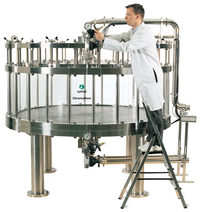
Large-scale bio-chromatographic separation requires specifically designed equipment like industrial chromatography columns. Separation of compounds occurs in columns, and it’s critical to choose the right empty column and pack it expertly with the chromatography resin of choice. When performing large-scale chromatography on automated chromatography systems, consider:
- Scale of operation – choose a column platform that’s scalable. Lab-scale columns are often used for process development.
- Type of media or resin.
- Chromatography resin lifetime.
- Maximum allowed process cycle times.
- Process steps.
- Recovery yield of target product.
Evaluating these parameters helps you determine the choice of column technology, column design, and material. The Purify app from Cytiva can guide you through the process for selecting chromatography columns and resins. Though prepacked chromatography columns are valuable options for some cases, reusable industrial chromatography columns can be an economical alternative. There is a wide range of column design options for good manufacturing practices (GMP) production.
Empty chromatography columns FAQs
Here are answers to some frequently asked questions.
What are empty chromatography columns?
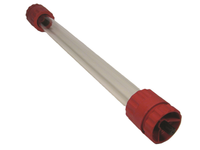
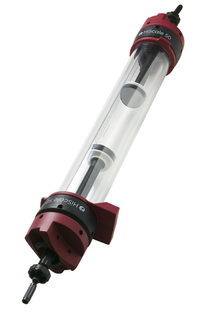
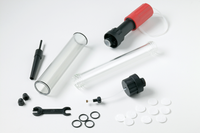
Empty chromatography columns for lab scale are glass columns used during liquid chromatography to separate molecules such as proteins from other molecules and substances such as salts. Process-scale empty columns are also available for large-scale purification. Column packing is required prior to use manually or with a liquid chromatography system. The chromatography resin of choice, for example, an affinity resin, an ion exchange resin or hydrophobic interaction resin, is added to the empty column in a controlled and consistent way.
What are the basic principles of column chromatography?
In column chromatography, solutes in the applied sample interact with the ligand of the chromatography resin inside the column. After sample loading, the column is washed with a mobile phase to remove molecules that don’t interact strongly. Then another mobile phase, the elution buffer, provides conditions to desorb the remaining molecules from the ligand.
What are the applications of chromatography columns?
Applications of empty chromatography columns vary widely in the pharmaceutical and petroleum industries, environmental or life sciences, and toxicology. The most common uses of column chromatography in life sciences and the biopharma industry are:
- Purification of molecules, for example, protein purification of antibodies for research
- Process-scale columns are commonly used to characterize, purify, and manufacture various products in the biopharmaceutical industry.
- Analysis of a sample to determine purity level
What goes into a chromatography column?
Liquid chromatography often involves the use of small particles or resins, which get packed and held in a column; this is also referred to as the stationary phase. Resins are based on different materials, such as agarose or dextran, which are prepared to have the desired physical and chemical characteristics.
What is process-scale chromatography?
Process-scale chromatography refers to large-scale separation of biomolecules to produce biotherapeutics, such as recombinant proteins, monoclonal antibodies, insulin and newer therapies such as viral vectors and nucleic acids.
What types of resins can be used?
Based on chromatography techniques, there is a diverse array of resins or media available to help purify a broad range of target molecules. Common types of chromatography resins to capture biomolecules include:
- Affinity resins
- Ion exchange resins
- Mixed-mode (multimodal) resins
- Hydrophobic interaction resins
- Desalting and buffer exchange resins
- Size exclusion resins
What are chromatography columns made of?
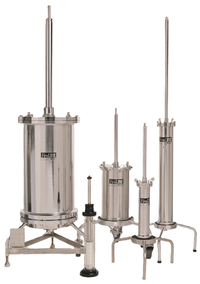
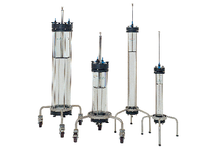
Empty chromatography columns can be made of borosilicate glass, acrylic or stainless-steel materials. Some fast protein liquid chromatography columns are made of polypropylene material. They range in size from a few millimeters in diameter for lab-scale to more than two meters for process-scale columns.
Do I always need to pack a column?
Lab-scale: You can choose to pack your own columns or purchase lab-scale prepacked columns.
Process-scale: Choose a process-scale column compatible with the pressure-flow properties of the desired chromatography resin or purchase validated prepacked columns for GMP manufacturing that are ready for use.
How do you pack process-scale columns?
A well-packed homogenous column bed provides the best separation results. Although details may vary, the common principle involved in process-scale column packing is to ensure that you consolidate the resin so it’s homogeneous. This helps reduce lot-to-lot variations and optimizes bed stability. Assemble and pack your column in the same room where you plan to run it. Automated axial compression packing supports situations that require rapid and reproducible packing.
Columns must be properly packed and qualified. Column efficiency testing is an important part of the qualification prior to use.
How to choose an empty column
Use the Purify app to help you find the right lab-scale Cytiva column for your application. For large-scale chromatography columns, contact your Cytiva representative.